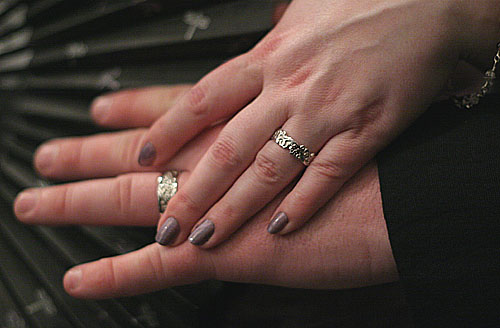
On 20 Years of Being Married

On April 24, 2025, my spouse and I commemorate 20 years of being married to each other.

This seems to be something of a remarkable milestone in this day and age, and certainly among our age cohort. For us, it is both unremarkable (because we intended for it to last from the start), and wondrous (because we have somehow managed it).

Of course, 20 years is not the entirety of it, because there was time that led up to the date of marriage. For us, that time is about a year and a half (though there’s a specific date within that time that we mark as the beginning of our romantic relationship). But that time is also kind of remarkable, and I haven’t fully told that part of the story before.

We first became acquainted in autumn 2003, in the shitposting forum of the Seattle gothic message board (and that is a collection of words that will really only make sense to a subset of people who were in particular times and places). He dropped into it with no difficulty at all and quickly caught my attention with both how readily he fell into the flow of it, and how consistently funny he was. This ended up being valuable; we had a good idea of each other’s humor (a thing that is absolutely crucial for a long-term relationship) and where we drew our lines on acceptable behavior even before we began a relationship.

Worth noting that at this stage, we were both starting over. He had recently ended a six-year marriage that hadn’t been a good idea to begin with, and he moved cross-country in August 2003, from Florida to the Salish Sea region; he was in the Air Force and the required PCS [permanent change of station] offered him an opportunity to start fresh. He chose the greater Seattle area deliberately, partly because of the climate and geography, partly because of the liveliness of the goth scene, and partly to get a new start far away from Florida. And upon joining the Seagoth scene, he quickly learned that being the New Thing made him very attractive, which became relevant later.

I was in the process of ending an eight-year relationship (seven years cohabiting) that had caused me a lot of damage (and which I would not fully understand the depth of for several more years). In September 2003 I told my then-partner that I no longer wanted to be involved with him; untangling financial issues and living arrangements took a couple of months, but the social life I had shared with this person had already separated entirely.

The in-person meeting between me and my future spouse was, absolutely true, at a Halloween party (hi, we’re goths). It was the first major social event I attended on my own since ending my previous relationship, and it took immense will for me to overcome the massive anxiety that going out as a newly single person caused for me. He attended on short notice, after a full 14-hour day at work; he came with a fellow Florida transplant that he was kinda-sorta seeing (because their shared Florida background had created a point of connection).

And even though this was our in-person introduction, in the end it was solely that: We were introduced to each other, shared our message board handles, engaged in small talk for a couple of minutes…and then didn’t speak again that night. Not a particularly auspicious or fated intro at all.

At this point of my life, my primary social activity was going to the weekly goth-focused night at a members-only goth/industrial/alternative nightclub. A good friend was the primary DJ for this night, the members-only status meant fewer creeps than the average nightlife scene, and it was on Tuesdays, so it was quieter than the weekends, which was beneficial to my anxiety. It gave me a chance to dress up, do some dancing, socialize at a low key, and simply be away from the stressors of my daily life for a few hours each week.

My new acquaintance was regularly attending ALL the goth/industrial nights in town (in part because this hadn’t been available to him in his prior circumstances, and in part because, well, his newness made him an object of interest), and he eventually realized that I was a regular at this particular club and night. So he started joining me to chat for a while. We learned more about each other through these chats, since it was generally just the two of us.

It didn’t occur to me that he might be…interested, y’know? Partly because I’ve always been extremely bad at gauging such things, partly because in the wake of my own recent breakup I had absolutely no interest or desire for such things, and indeed was looking forward to a future as a happily single cat lady. It was just enjoyable to chat with him and I thought of nothing beyond that. And he regularly circulated around the club talking to others, as he is quite a social butterfly. So he was just someone I enjoyed seeing at the club and I didn’t think of anything beyond that. This remained the case for the next few months.

Somehow, for reasons that are lost to time now, there was a challenge over who was best at trivia (this may have arisen from him learning that I had once been a contestant on Jeopardy!—my priors were solid), and it was eventually decided that there would be a Trivial Pursuit game at the club on Christmas Eve Eve (that is not a typo). Someone brought a box with the game and we built teams, with me on one team and him on the other. And in the end, the team he was on won, to his immense satisfaction. (In reality, both teams were very close in total correct answers, but once my team had filled up all our slots, we had the damnedest time getting to the center for the final question. It was less about ability than about how the die fell.) But the more notable thing about that night, for me, was that every time I looked up from the board/cards, he was looking at me, very intently. And it began to occur to me that maybe there was Interest.

But I tried to put it aside because I didn’t want to ruin our enjoyable friendship. And we continued our friendly conversations at the club over the next few weeks. And then somewhere in there, he learned he would be deploying to Afghanistan, for six months, in the first part of February. That became a marker in conversations.

The anniversary of the goth-focused night was the first week in February 2004, and my friend the DJ wanted to hold a party that night to celebrate it. I volunteered to help, and once the theme (a celebration of the dead of winter—look, it was a GOTH NIGHT) was decided, I went all in: I designed the promotional flyer, organized people to help with decorating, provided most of the decorations (including making over a hundred paper snowflakes), and did my own relentless promotion of it. On February 3, 2004 (running into February 4), we threw our little nightclub party. And it was a smashing success: There was a new record for attendance for that night, people loved the theme, and there was an incredible amount of laughter and joy and community. So many people thanked and complimented me for all my work in making the event happen, and I was glowing and joyous and hugging everyone because I was so happy.

Me at that club night party, in a ridiculous theme outfit that, believe it or not, I already had in my wardrobe. There are only a few photos from that night, and none of us together, fittingly.

My newish club friend came to say goodnight to me before leaving, a goodnight that was especially piquant as he knew he was deploying soon. As I was doing with everyone, I gave him a goodnight hug…and he held onto it just a little longer than necessary, and whispered something in my ear that was kind of a joke but also had profound seriousness under it. (I could say that I’d be reluctant to share the specifics of something that intimate, and I am, but also…I was so emotionally overwrought that night that I can’t actually remember the words with reliable accuracy.)

It was absolutely, 100%, for real a moment when time stopped and a thunderbolt hit. The air between us became pure electricity and absolutely everything else ceased to exist as we stood there in a half-embrace, with his whispered words hanging between us. And then for a second I thought he was going to try to kiss me, and I panicked, and I turned away to prevent that. The final goodnight was a little awkward.

It was a very late night for me, as once the club closed we had to take down all the decorations and clean up, so I didn’t have much space or energy to think about the odd, awkward thing that had occurred. The next morning, in the light of day, I wasn’t totally sure it had happened or that I was interpreting it correctly, and I decided to just set it aside and get on with things.

And then a couple of days later, he posted that he was having great difficulty finding someone to foster his dog while he was deployed and was worried he might have to surrender her to a shelter. I wasn’t in a position to foster the dog myself, but I didn’t want him to lose her and was confident I could help find someone to do it. So we began emailing about the dog and what kind of foster situation she needed, necessary details for solving this problem.

And somewhere in those conversations, I decided to go ahead and mention the weird thing that had happened between us at that club night, sure that he would have no idea what I was talking about…and instead he confirmed that he’d felt it too.

He was less than two weeks from the deployment date. And I didn’t know what to do with what had happened.

In the end he was fortunate that a friend had the capacity to take his dog in. And that ended the specific reason that we’d been emailing. But…we didn’t stop emailing.

Ove the next few days there was another night at the club (on a Saturday, when I didn’t usually go) in addition to the usual Tuesday, and calling in “sick” to work to hang out in downtown Seattle, and a hug on a streetcorner that lasted through three light cycles, and a kiss in a mall parking lot, and my cat (who had absolutely hated my ex from the start) refusing to get off his lap, and a dinner that I dressed up for. And more. We squeezed the first three months or so of a relationship into about a week, and it was heady and overwhelming and unreal.
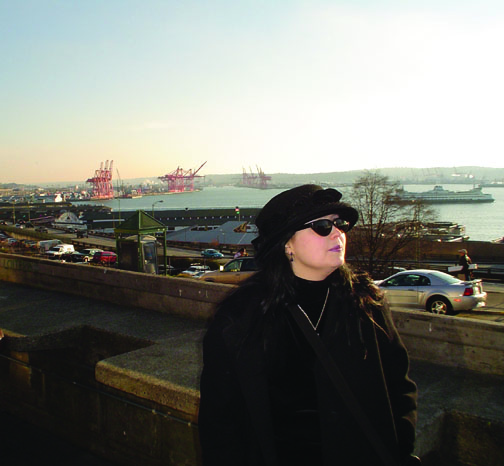
A photo he took of me at Pike Place Market on the day I called in “sick” at work.

But we couldn’t stop time and eventually he was up against the deployment date. We said a final in-person goodbye, promised to stay in touch to the extent possible (he didn’t yet know what kind of communications access he would have where he was going), and made no other promises except for him promising to return in one piece.

The process of deployment took several days (this is just how it works, apparently) and there were some phone calls as his unit hopscotched across the U.S. But there were also Livejournal posts from other people, and an odd uproar on the message board that his name got dragged into. Remember the part where I said that he was the attractive New Thing? Well, he’d availed himself of what came of that…and it appeared he hadn’t been entirely forthright with everyone involved. And that was a little concerning.

On one of the calls, I asked him about this, and he insisted that it was just a misunderstanding and explained it all. I still felt weird but I accepted it. I didn’t care much about whether he’d been seeing anyone else (we hadn’t made any agreements or set expectations of exclusivity—there wasn’t really time for that to happen), just that everyone affected be informed and clear about all of it.

And then a little later, on the verge of getting on the plane to leave the country (and be out of contact for at least a few days), he called me back and admitted that he had not quite been truthful in the last call, and that he had indeed not been entirely forthright with everyone. And then he got on a plane to another country.

He has acknowledged many times since then that he was, in his words, “a scoundrel.” He did not know how to handle all the changes in his life, along with a looming deployment, and he did not make good decisions. And in the times he was able to call me (and at least one other person) over the next several days, he had those poor decisions reinforced by the anger he was subjected to. (Again, I cared less about who was involved than I did about honesty and informed consent, which he did not handle well.) And there was a point at which I said I was done with any further conversations. It turned out that there wasn’t really opportunity for him to contact me for a while, as the remaining travel to his destination happened without options for calls, and he reached his destination and was introduced to the experience of being in a combat zone. And I used those several days of calm to reorient myself to my own life and get things back to normal.

When he called me again, he’d been through a few nights on patrol, and he asked me to please at least listen. He said that what he’d seen and experienced had changed him, that he understood that he had made mistakes and needed to be better, and that he hoped there would be something for him to think about returning to. And I listened, and decided that I would take him at his word, because there was something in me that just wasn’t ready to let go of who I thought he could be.

And that was the beginning of a relationship conducted largely in time-shifted emails, text chats at odd hours, a single phone call a day (if we were fortunate) that could be a couple hours or five minutes, and a handful of actual postal letters. The time difference was eleven and a half hours so one of us was always starting our day when the other was getting ready for bed. Each of us stayed up way too late on too many occasions. But the time-shifting also gave both of us the time and space to write thoughtfully, with care, and in depth. I gained new appreciation for the value of epistolary relationships (those 18th-19th century folks had something there) and for the way the constraints of separation changed how we related to each other and handled our interactions.

With nothing to do but talk or write, we learned a lot about each other, far more than we had in those conversations at the nightclub. We went into depth on our backgrounds, our families, and the painful relationships we’d both recently left. We discussed politics, values, ethics, and principles; we had differences, but the ability to discuss them in depth and in writing did a lot to find places where we were in accord. We went long on our interests and found we had a lot of them in common.

And eventually it became clear that we had found our way past the uproar and were into something that felt like it would continue to blossom. I told him stories about things going on with Seagoth, at the club, in Seattle; he told me about the violent absurdities of a combat zone and things he witnessed. He called me after members of his squadron were injured by old mines and told me how he couldn’t walk on any unpaved surface anymore. One morning he woke me up with a call and said, “I’m sorry, I broke my promise”—because he’d accidentally broken bones in his foot and wasn’t in one piece. (I forgave him for that.) I learned that he knew how to calm me, even at all that distance, when I spiraled into anxiety about my job, moving to a new apartment, trying to manage multiple priorities at once. He learned that I knew how to hold his fear and damage (because there was new damage simply from him being there) with care and help him find purpose beyond the war he was in the middle of.

I want to be really clear: Without this time of separation, we would not have a relationship. If it had all been in person, if we’d had to deal face to face with the febrile risk of limerence and the impact of his less-than-ideal decisions and the damage we were each carrying, we would absolutely have flamed out, one way or another. Those months of separation, time-shifting, and risk for him forced us to be more deliberate, to treat our conversations with care, to focus on what mattered in the core of each of us. I do not recommend war as a relationship device, not at all, and it was absolutely not enjoyable to have the separation. But for us, it ended up creating the circumstances for us to determine who we each were and what we were seeking. And as we found and shared those things, we became increasingly certain that we had something remarkable, and that we wanted to keep going.

The deployment was more than six and a half months in the end. He returned in the middle of me planning the memorial service for a dear friend who died suddenly and the grief and stress I had around that; it was very strange to be so happy and so full of sadness all at once, but he held up through it and for me. And I helped him navigate the return to a more normal life and the realization that he had PTSD.

And despite concerns we both had about resuming a relationship in physical proximity, it quickly became clear that what we had was wondrous, and that neither of us wanted to stop. Things weren’t perfect, but the skills we’d built over the months apart helped us through the challenging moments. And it started to feel like there was inevitability.

He asked me to marry him on October 12, 2004, six weeks after he returned from deployment and two days before my birthday. It didn’t come as a surprise; if he hadn’t gotten around to it within a few more weeks, I’d have asked him. He proposed on the dance floor at the club where we had first gotten to know each other and where a moment of thunderbolt and electricity told us to pay attention. It was quiet and private, not a big production, and in fact we didn’t tell anyone for a couple of days. (You can read the engagement announcement I wrote here.)

Later that month, we once again attended the Halloween party where we’d first met in person…costumed as Morticia and Gomez Addams, because that is, after all, Goth Couple Goals.

The perfect goth couple.

A little over six months later, we officially married.

Our wedding was held on a vintage ferryboat moored on Lake Union in Seattle; the ceremony was on the deck, with the city as backdrop, and then we had a delightful party inside. Our processional music was the theme from The Princess Bride. Our first dance was to Aztec Camera’s version of Cole Porter’s “Do I Love You,” and our final dance of the night was to “Storybook Love” by Mark Knopfler and Willy deVille, from the soundtrack of The Princess Bride. Every moment of it was perfect, even when everything didn’t go completely as planned.

Our wedding was the result of dozens of people in our community pitching in, for everything from our clothes to the décor to the cake to the music, and I am still so grateful to every one of them. Our wedding wasn’t “big” in the way the wedding industry defines that term, but there were a lot of people there, because it was crucial to us to share this milestone, this moment of transition, with the people who had helped us become who we were. I still think of that night with immense joy and gratitude, that this enormous life passage was exactly what I wanted it to be in all the ways that mattered.

The front of our wedding invitation, which I designed and did the layout for. Yes, we are VERY goth.

Of course, the wedding wasn’t the end of our story—it was the beginning of what we hoped would be our happily ever after. And it wasn’t that we married because That’s What You Do; we married because we knew, in ourselves and through long conversation, that we wanted to make that commitment to each other and to the life we wanted to have together. (And there were practical issues too—he got military benefits from being married that made our life together a little easier.)

So what has it meant to be married for 20 years?

For us, it’s meant knowing there is someone who loves and cares and supports and relies on you. It’s meant having someone to come home to and to help solve problems, someone to provide comfort and laughter and a meal and a cocktail, as needed, and to fill in where needed to support each other’s weak spots.

It’s meant supporting each other through the grief of losses, family members and friends and the pets we’ve brought into our home to be part of our family, and through the stresses of life, from a bad day at work to the COVID pandemic and the nightmare of this country’s democracy falling apart.

It’s meant so much laughter and so much silliness, memes and puns and dad jokes and obscure references that only we will get and ridiculous gifts and things our pets do, and parties where we get to share our home and our laughter with other people we care about. I have told him repeatedly that while I didn’t marry him because he makes me laugh, I would not have married him if he didn’t.

A dinosaur making a cocktail, very normal.

It’s meant adventures of all kinds, starting with that very first (and very, very big) one. Some adventures are small: Let’s go explore this part of our area, or let’s try a restaurant we heard about. Some adventures are huge, like moving cross-country to New Jersey for three years when he became a federal law enforcement officer after leaving the military, and then him quitting that job and us moving back to Seattle with nothing set up on the other side. Some are capers: Sneaking around closed event spaces on the Queen Mary after hours in formalwear and dancing in a hallway to “They Can’t Take That Away From Me,” or the time we crashed an outdoor wedding reception and had a long conversation with the bride’s three-sheets-to-the-wind father. Some are wretched, like our water heater lines forcefully disconnecting and flooding the lower level of our house, or when we both got COVID three years into the pandemic and had to isolate for nearly two weeks; some are sublime, such as watching humpbacks bubble netting in the waters off Juneau, or the two weeks we spent in Scotland last October.

It’s meant introducing each other to new things, and discovering new things together. He introduced me to wine (which I’d thought until then I didn’t like and now love) and cocktails, and the particular quirkiness of south Florida; I introduced him to fandom/media conventions and the fun of cosplay, and the awe-inspiring beauty of the Cascade Mountains. We shared our favorite films and shows with each other. Together we’ve discovered how much we love ice hockey, and film noir, and volunteering as naturalists, and so many beautiful places we’ve been to together.

A portrait I commissioned for our anniversary in 2024 to reflect our love of Seattle’s NHL team, the Seattle Kraken. Art by Ethan Kocak.

It’s meant working through the challenges, conflicts, and harm created by our own individual traumas and dysfunctions, and reinforcing the things that brought us together.

It’s meant navigating and understanding different frames of reference, from the differences in our class upbringing to expectations around issues such as money and housework to cultural frames due to age differences. (Oh yeah, he’s 12 years younger than I am. And absolutely true, I had a brief period of doubt when, as a postpunk kid, I realized he wasn’t old enough to remember the Sex Pistols.)

It’s meant figuring out how to work out serious disagreements with care and love and regard for each other, and what to do when we cause each other pain. Our wedding vows were statements of intent and permission, and one of them was, “Will you make each other angry?” “I may.” A number of guests laughed at that, but it was as important as the more traditional statements of love, partnership, and commitment.

It’s meant finding the pop culture references that reflect and explain us; for the sake of length I’ll avoid the full list here (you can see it at the end if you really want), but the first one was Nick and Nora Charles from The Thin Man films: detective stories, lots of cocktails, fabulous clothes, endless wisecracks, and devotion to each other. We still playfully call each other Mr. & Mrs. Charles and our home is The Charles Estate.

A reasonable facsimile of one of our parties.

And it’s meant supporting each other through a variety of health issues, some of which eventually healed, some of which are chronic, and one of which shares its start with our anniversary date—on our anniversary trip in 2011, I tripped on some stairs and ended up with neuromuscular impingement/damage that caused Bell’s Palsy I didn’t fully recover from, so our anniversary will always be linked with that.

It’s meant a lot of numbers that for me help measure the scope of all we’ve done since we married:

  • 5 homes lived in (4 rentals, 1 we own).
  • 2 states lived in.
  • 2 cross-country moves made.
  • 3 dogs and 5 cats (so far).
  • 4 cars (3 of which were technically his).
  • 4 employers for him, 3 for me.
  • 1 business started, which he began after he left his federal job and we returned to Seattle, and which we now own and work in together.
  • 4 significant surgeries between us; 3 ER visits for each of us; 1 broken bone for each of us.
  • 7 states visited together, plus 1 U.S. territory and 4 countries.
  • The equivalent of more than a year living apart due to assorted military and federal training requirements.
  • 3 months living in 5 motels after we moved back to Seattle (it took that long to find a home that met our needs & we could afford).
  • 2 hurricanes (Katrina, which we flew through *twice*, and Sandy) and 3 tropical storms experienced (one of which was in Seattle!), plus 1 significant earthquake (in NJ, with epicenter in VA, NOT in Seattle).
  • 1 viewing of Aurora borealis (in Seattle, in May 2024—but we’ve been to Alaska twice and never seen it there!).
  • 3 fashion shows (this is what happens when you’re goth, you end up knowing a lot of clothing designers).
  • Countless wine tastings done, cocktails shared, restaurants visited, special meals prepared, day trips undertaken, all of it part of joys that we have in common and that are sweetened by doing them together.

For us, marriage was not “this is just what you do if you love a person”; it was a considered, discussed, deliberate decision, that we made because we were confident the form and depth of our feelings for each other was meant to be long-term, and marriage was the best option for formalizing that. And we were old enough, experienced enough, and self-reflective enough to consider all of these factors and examine them before we made this choice and commitment. (And that is part of the reason that those six and a half months of separation back at the start were so crucial to how we made it to 20 years.)

Photo taken at Norwescon in 2008; I have misplaced the name of the photographer.

I hope for everyone who chooses to marriage to take a similar path. Don’t marry just because of limerence or desire; marry because you can’t envision living a life without this person in it and alongside you, for decades to come. The moment I knew this was what I wanted was when I found myself envisioning waking up next to him when I’m 80 years old.

And no, it hasn’t all been easy and joyous every moment; there have been hard times and there will be more in future, and don’t believe anyone who says they never have those moments. But what makes it work is our choice to find our way through those moments and try to improve and repair what’s gone poorly, because our marriage—our commitment to sharing our life together—is so important to us. A marriage is an entity, a living thing that is created by the people in it, and we are the ones responsible for maintaining that entity and making it grow and thrive.

I’m so glad, still, to be with him. We fit so well. We finish each other’s jokes and say the thing the other was thinking, because after all this time, we understand each other so well that we know what the punchline will be. We often anticipate what the other is going to suggest we do. We know what gifts (serious and jokey) that the other will like best. When we discuss business, we’ll work out our ideas and theories on a case in real time, coming up with pieces together and impressing each other with what we find out. (He’s a private investigator and I’m the operations manager—the Effie to his Sam Spade.) And we have maintained the sense of romance, the fairytale love and wisecracking delight and swooning devotion, because those things have never stopped being part of who we are and what our marriage is.

Here’s to 20 years of being married to my adventure co-conspirator, my business partner, my household support, my fellow pet guardian, my mixologist, my comedy relief, my always-there friend, the deepest and most sustained love in my life. Here’s to (hopefully) making it to 50 years, for all the reasons we’ve made it to 20.

Happy anniversary, Mr. Charles.

We Are Hopeless Nerds

So, if you actually got this far, I guess you want to read it: The list of other pop-culture characters that we are, in addition to Nick and Nora Charles. Here ya go.

  • Tony Stark and Pepper Potts from the MCU Iron Man. (This started with the very first film, including the Afghanistan sequence, and has remained very relevant; he has cosplayed Tony numerous times.)
  • Sterling Archer, with a bit of Krieger (him); bits of Lana Kane, Mallory Archer, and Pam Poovey (me), from the animated series Archer. (There are times when he is being particularly Archer-ish that I have to say in exasperation, “NOT A ROLE MODEL.”)
  • Jake Peralta (with a bit of Rosa Diaz) for him, Amy Santiago (with a bit of Kevin Cozner) for me, and differing pieces of Raymond Holt for each of us, from Brooklyn 99.
  • Lucifer Morningstar and Dr. Linda Martin from Lucifer. (No, I am not really Chloe—I am DEFINITELY Linda.)
  • The best (and a bit of the worst) of Eleanor and the Floridian of Jason (him), and most of Chidi (especially the anxiety and decision paralysis) and the know-it-all-ism of Janet (me) from The Good Place.
  • Dewey Duck and Webby Vanderquack from the latest version of DuckTales.
  • Beast Boy and Raven from Teen Titans Go! (Someday, if the world is safe enough for us to go to a convention again, we want to cosplay the elderly versions of these two.)
  • Bob Belcher (me) and both Gene and Louise Belcher (him) from Bob’s Burgers.
  • Combo of Ron Swanson and Andy Dwyer (him), and Leslie Knope and April Ludgate (me) from Parks & Recreation.
On the Edge of Spring

It’s the middle of March, and the past couple of days here in the Seattle area have been mild and sunlit with clear skies. This is when those of us who live here know spring is on the way. It’s not that this weather will endure; we will have many more days of gray skies and drizzle before spring fully takes hold, and those days may spill well into summer. But days like this tell us that spring is coming, that the trees and flowers are budding, that the darkness of winter is on the way out.

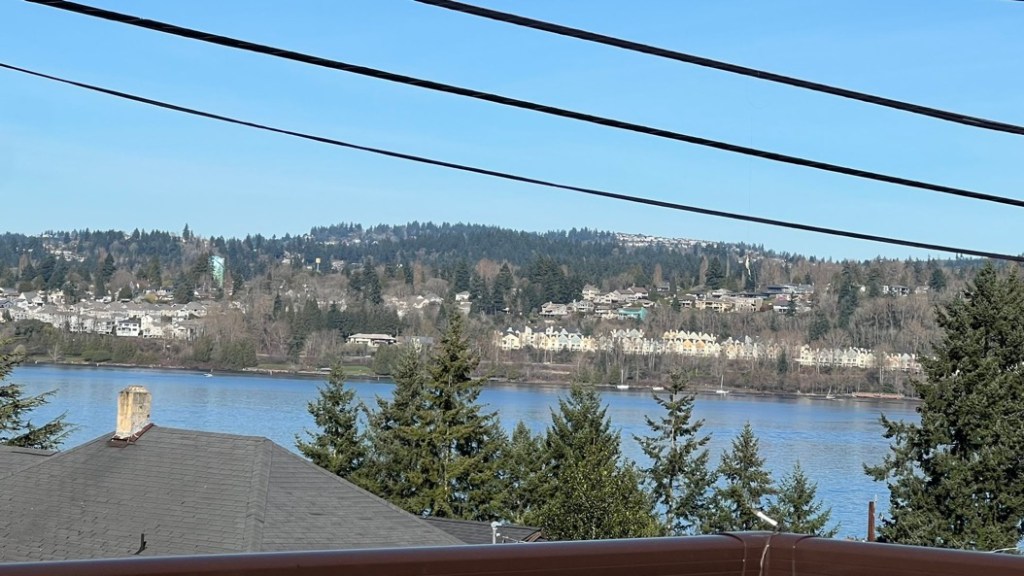
When days like this happen, my spouse and I like to do what we call Balcony Afternoons. We have a balcony directly off our bedroom, large enough to accommodate us and some lounge chairs and a small table and our pets (as well as a feeder for the hummingbirds). Our house is at the south end of a lake, and while our neighborhood is decidedly humanized and suburban, we can see the lake and the hills that ring it and the birds that float and feed on it and old growth trees that haven’t been torn out to make space for the humans, as well as the soaring sky. These days are brilliant and precious, and we want to experience them and cherish them. We go outside for a couple of hours with a bottle of wine and some snacks, and just enjoy the time outside.

We’ve lived in this house for seven years (as of the end of this month). It was always intended as not just a home but a refuge, and for more than half the time we’ve lived here it’s been a near-constant sanctuary from the pandemic as well as our home. We chose this house because of the lake and trees and birds and balcony, among many other reasons, and we cherish those things each day but especially on days like this.

The past several months have been…a lot. We’ve had individual and family struggles, including death and injury and illness and turmoil. Six months ago, I quit a job I’d held for nearly a decade, after years of overwork and burnout and unmanageable expectations, and it was less to go to something new than it was to simply end the ongoing damage. I’m still not recovered from that and I don’t know when I will be. I’m still figuring out who I am outside of that job and that workplace and whether I’ll ever return to a lot of things I love to do (which, not gonna lie, included things I did in that job). But on this edge of spring day, I can feel both respite and hope as I sink into the view and the warmth and all the signs of the world cycling back to spring for this year.

I’m a native of the Pacific NW, and I’ve lived here the majority of my life. I know the rhythm of the seasons here and I expect the darkness and damp of autumn and winter. To be honest, I cherish autumn here; the first part of it remains lovely and dry more often than not, with pleasantly crisp days and autumn colors and the pleasures of coziness, and then comes Spooky Season, which I especially appreciate as an avowed goth. I love autumn twilight and bare branches and mist and the need for extra light, as we move towards the prime gothy holiday; and even after All Hallow’s Eve, we move into the defiant sparkle and hearty pleasures of the end of year holidays, which help stave off the worst of the dark and damp as we approach the winter solstice. But I won’t lie: the time after those end of year holidays and through January is rough, and eventually even I have had enough of the dark and damp.

That’s why these days on the edge of spring are so precious: they are the end of the rough dark times and a sign that brighter times are ahead. I will luxuriate in the brighter, warmer days of spring, in the return of spring/summer migrants and the blooming flowers and the phenomenal greens that we have in summer to complement the evergreens we’re fortunate to have year-round and the opportunity to sit on my balcony and revel in the lake and sky and trees. Eventually it will get hot (which didn’t used to happen, but our climate is broken so it’s always hot in summer now), and things will get dry and brown, and we’ll probably have fires and smoke that make summer difficult to fully savor. When autumn comes around again, I’ll be more than ready for it. But right now, we are in the part of the cycle where the dark and cold starts to retreat and the brightness returns, and right now I need that.

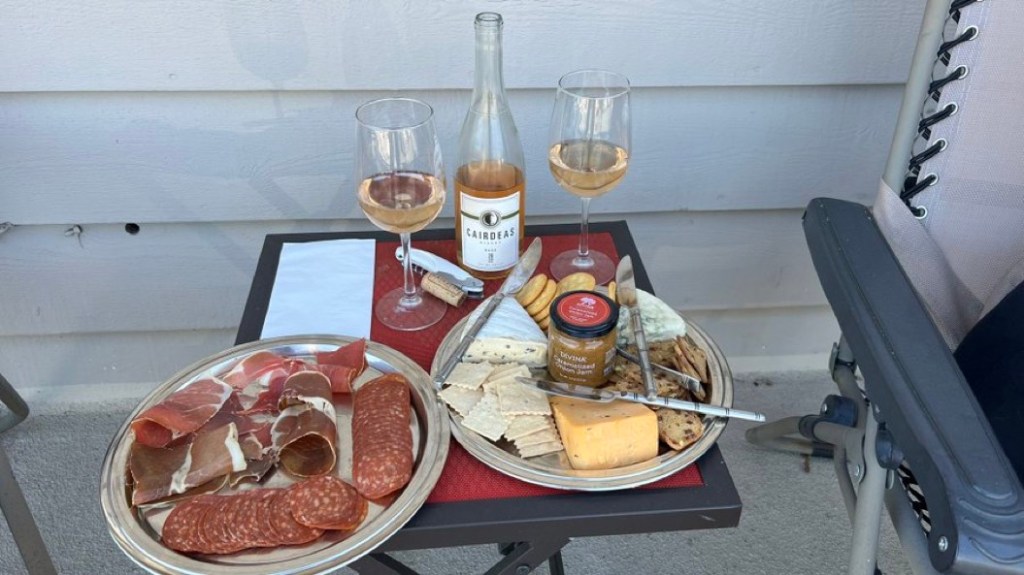
Today we had a rosé from a favorite winery in the central part of the state and some delightful cheeses and a luscious onion jam (and charcuterie for my spouse). One of our neighbors ran his power washer for a couple of hours; when he finally shut it off, the absence of its noise highlighted the pleasant background noise of our neighborhood. A Bewick’s wren sang his burbling running-brook song, because it’s that season, and the chickadees and Steller’s jays called at each other. A pair of adult crows billed and groomed atop a tree down the street, while the adolescent crows fluttered around the neighborhood in a gang, yelling and playing. Nothing unusual for this time of year…but special and beautiful all the same, every time. And I’m grateful we have more of this to come as spring fully expands.

Noir City: Day 3

Day 3 was all Japanese 1960s gangster films that also crossed over into noir. I have a long-standing love for Japanese gangster/detective films generally; there is something about the style of these, the way they break the conventions of Japanese propriety while still exploring Japanese mores, that I find extremely compelling. So three of these films, of wildly different tone and style, was really a feast.

A Colt is My Passport: This film is fairly famous in the U.S. but somehow I’d never encountered it before. It’s a moody, atmospheric story of a hitman’s existential challenges that also contains a couple of the most wildly-imagined shootouts I’ve seen. A hitman (the legendary chipmunk-cheeked Joe Shishido, a.k.a. “Joe the Ace”) is commissioned to take out the boss of a rival gang, but the way he chooses to do it angers his own gang as well as the rivals. When their escape plan falls apart, he and his apprentice are sent to a small seaside town to hide out until things cool off, unaware that agreements are underway that will make them collateral losses in a larger plan. They find unexpected allies in the truckers and ship workers, as well as a young woman with a story of her own.

The story here is fairly straightforward; the joy is all in the telling. The film synthesizes a number of other film elements of the time, including nouvelle vague camerawork and story structure, spaghetti western blocking and closeups as well as music (love the flamenco-flavored jazz on the soundtrack), and the “doomed protagonist running out of time” conventions of American noir, all expressed with uniquely Japanese style. The way all of the gang members show up everywhere in sharp suits, no matter the setting, emphasizes Japanese propriety and the importance of role and status. The use of many natural elements like birds, insects, and the waves and wind in the hitman’s decisions call to mind aspects of classical Japanese poetry and Shinto. And the final confrontation, rightly notorious, is over the top, absurd, and yet perfectly in tune with the rest of the film.

Is it noir? It’s noir enough for my purposes. The overall tone is right, and the sense of racing to beat impending doom along with betrayal certainly fits. Even Mina, the woman who brings her own backstory to her interactions with the gangsters, is well in line with the tradition of complex noir dames, including holding on to her agency and refusing to be intimidated. I might not have considered this a noir film if I’d seen it outside this context. But in this context, it’s a great fit.

Branded to Kill: This was the film that made be bounce and clap my hands in glee when I saw it in the listing for this year’s Noir City. I’m an unabashed fan of the deliberate chaotic weirdness of Seijun Suzuki’s films, and my introduction to his work was Tokyo Drifter, so seeing another gangster pic from him, in this context, was a joy. And it also meant introducing my spouse to Suzuki, on a big screen, which couldn’t be better.

There is theoretically a plot to this but it’s not all that important. Joe Shishido is our star again, and again playing a hitman, though this time far more dramatically than in the previous film. There’s a framework of a legendary “ranking” of hitmen with everyone desiring to be No. 1. And there’s an instigating incident when our protagonist encounters a mysterious woman who hires him to carry out a highly specific, absurdly difficult hit. But everything around that is just surreal, delightful weirdness.

There’s a hugely dramatic story surrounding the existence of this film, built on the notion that Suzuki didn’t have the resources to make a coherent, saleable movie, and ended up being fired for his inability to deliver. But c’mon. There’s nothing unintentional in this film, and Suzuki always did just what he wanted to do. There’s a lot of deliberate surrealism, timelines broken out of all coherence, avant garde camera work, and over the top performances. It’s highly (almost comically at points) symbolist, and it includes elements I’ve seen in other Suzuki films referring to the conventions of traditional Japanese theater styles. And sometimes it’s just funny and dumb, because it can be. All films about hitmen are fundamentally existentialist and wrangling with the presence of mortality, which is something they have in common with many typical noir concepts. Very few such films are as deliberately outlandish as this one, though.

Did I enjoy it? Of course I did. I find Suzuki’s films exhilarating in their weirdness, even when they don’t totally work (which is often, and which this one doesn’t in several points). There is real joy in watching an artist throw out all expectations and make something weird; and while you might not like or agree with Suzuki’s choices, he was always very good at what he was doing even if the result was chaos. He’s one of the best examples of an artist who understands his form well enough to break the hell out of it. You should finish a Suzuki film alternately laughing manically and with a headache from the bizarreness.

Oh yeah, and it was a successful introduction for my spouse. At multiple points I caught him grinning and giggling gleefully. So there will be a trip to Scarecrow Video for Tokyo Drifter and Pistol Opera, at minimum, in the near future.

Pale Flower: Going from Suzuki’s chaotic existential carnival ride to the quiet, measured melancholy of this film was a big shift; but it was also an excellent demonstration that the genre can contain so many styles. Another hitman story, another mysterious woman, another reckoning with mortality, this time in a way that asks the viewer to travel into the loneliness of this life.

This time our hitman is recently out of prison for a previous killing. In the time he’s been away his gang has formed an alliance with the gang he killed a member of, which leaves him uncertain of where he fits in. Drifting into a gambling session, he encounters a young woman who bets recklessly and intrigues him with her sensation-seeking approach to her existence, even as he struggles to figure out the meaning of his own life.

There’s an unexpected delicacy to this film, even though there’s nothing delicate in the story or characters. Every moment feels achingly evanescent, framed in gorgeous use of light and shadow and camerawork that emulates the way people look at each other and around them. The soundtrack builds the music on the sounds of the actions onscreen, like the clicking of gambling tiles and the betting call of the dealer, the rhythm of city trains and cars on city streets, the actions of people eating and drinking. The performances are measured and slightly opaque; we aren’t meant to know exactly what the characters are thinking, and it contributes to the sense of loneliness that suffuses the film. Despite this, I didn’t find it depressing or nihilistic; it’s more of a meditation on how we find meaning in our existence, and how we deal with the consequences of our choices. This is a genuinely lovely expression of this eternal search, and an essential noir concept.

This was an unreservedly excellent day of screenings, and gave me new ways of thinking about the idea of noir.

Outfit Details

Noir City 2020: Day 1

…or maybe I should say Night 1, since, y’know, noir. They are doing some daytime screenings. But it’ll mostly be nighttime. In any case, last night was opening night for this year’s Noir City in Seattle and we were there.

We’ve gone to some individual screenings at Noir City in Seattle three of the past four years. It was always a wonderful time, offering the opportunity to see some beloved classics in a cinema setting, see some classics of the genre I hadn’t seen before, and discover some films that I didn’t know about. But we always had to choose a few and cluster them on the weekend because of both cost and my work obligations, and it meant agonizing decisions and major FOMO. One year we had to miss Shadow of a Doubt. Last year I’d have gladly swapped two of the films we chose for two different ones based on reviews from a friend.

For this year, with some changes in my job responsibilities easing my schedule, and my desire to minimize missing out, I decided that we would get passes for the full series. We can choose any screening we want for the duration of Noir City. And for the first time, we hit both opening night screenings.

I bought the passes before the schedule was announced. Previous years have been a mix of known films of various levels of fame with more obscure works; sometimes there was a rough theme, like all 1950s works. I was eager to see what we’d get this time. When the schedule and theme were announced, it was unexpected: Noir City International, with all the films from countries other than the U.S. And at first I was taken aback; would I get my money’s worth when nearly all of the films were unknown quantities?

But as I read through the listings and descriptions, I got increasingly excited. One of the reasons I enjoy noir is sociological; I’ve been fascinated by the ways different eras of U.S. film interpret this often harsh genre and express the cultural themes of their time. (Early 1940s noir tends to be more mystery-focused; immediate post-WWII noir is often about how badly the American Dream has failed people; 1950s noir tends to lean more on examinations of masculinity and concepts of “good” and “bad” for women.) How exciting would it be to see those sociological elements as explored in noir from other countries? By the time we got to the Egyptian I was practically thrumming with excitement. And the opening night films delivered. Both from Argentina, both versions of other works framed through the viewpoints of an Argentinean filmmaker working in the early 1950s, both little-known until recently, they gave me the sociological meat I craved along with great entertainment.

(note: There’s some discussion of plot points below, and for one of the films a comparison to another very well-known work. If you don’t wanna know anything, skip the next couple of paragraphs. But I hope you’ll consider that knowing plot points is not the entirety of a film experience.)

Something I noticed about both films was a high level of emotional intelligence, and a marked lack of the kind of simplistic sex roles and celebration of toxic masculinity that is often present in American noir. The protagonist of The Beast Must Die (which is based on the famed novel by Nicholas Blake) weeps from grief, has a breakdown due to that grief that is presented as a natural outcome, respects the autonomy of a woman who is attracted to him (even though he ultimately admits that he’s being dishonest to her for his own ends) while trying to protect another, and tells a boy that his fear of abuse and tears at being unable to help his mother are evidence of his strength of character. Two of the male characters who exhibit what’s often thought of as typical male behavior are presented as despicable; some of this is plot-driven but it’s also clearly meant to demonstrate that such behavior is unacceptable. The women characters are complex; there’s no good girl/bad girl dichotomy as might be the case for women in an American noir but instead a clear understanding that they are trying to make the best choices they can in a world that isn’t favorable to them.

The Black Vampire is a retelling of Fritz Lang’s iconic M; while I haven’t seen that film in quite a while, the story beats in The Black Vampire map fairly closely to those of the earlier film from what I recall. What’s markedly different in this version is the presence of women. Three women characters have vital roles in this story, and help reframe both the actions of the killer and the behavior of the investigator trying to catch him. Two of the women work at a cabaret that is offering the services of sex workers (unspoken but made clear through references); despite the attempts of some of the male characters to degrade them for this, they refuse to accept the derogatory labels and emphasize, again, that they are making the best choices they can in an unfavorable world. There are multiple instances of women asserting their autonomy against the desires of men. Many of the women characters offer kindness to the killer in various ways, which helps highlight the torment of the killer at the impulses he can’t stop himself from acting on while also demonstrating that the excuses he tells himself are nonsense; there’s nothing special or exculpatory about the ridicule and lack of attention he’s experienced. The women also show the driven investigator that his genius and high status don’t excuse his misbehavior and entitlement; they will not be the collateral damage in his efforts to capture the killer at any cost.

But both films totally honor the feeling and themes of noir: The harshness of the world we live in and the consequences of the choices the characters make, often at risk to their own existence and integrity. It was a terrific way to start off this year’s Noir City and I’m very eager for what else is to come.

Noir fashion highlight

Modern Märchen

Today I went out for a walk in the park, which is a thing that I normally do. I have a standard route and I know how long it will take to walk.

Unexpectedly I was forced to make a detour from my normal plans.

I found myself in an unknown place, and shortly came to a bridge I had never seen before. I was startled to find this bridge, and nervous; what might lurk beneath it? With great trepidation I crossed the bridge and continued my journey.

And suddenly I realized that I was lost in the forest, all alone, with no idea which way to turn to return home and a foreboding path ahead.

I thought perhaps the forest dwellers might come to my assistance; but there were no magical beings or woodland creatures nearby, just the dark shadows of the forest.

After a few moments of wandering, I remembered the oracle I had in my pocket. I asked it for help and it slowly guided me out of the forest and to the right path.

I made my way to the gate that would take me home, but things were not right. I returned to my base knowing that time had slipped away and I could not control it.

But I am grateful the forest did not try to keep me.

A Translation for our current time

Of historic moments and memories

My earliest political memory is Nixon’s resignation. I came into the TV room and my grandfather seemed agitated so I asked what was going on and he said the President was resigning. I understood that it was a major thing but I didn’t really grasp any of the context because I was too young. I don’t recall any particular mood or conversation around my house in the runup or after; I was a little kid, I cared about books and bike rides and exploring the neighborhood, and my grandmother had died the year previously so things were still fraught in my family. But a President resigning to avoid being impeached was the start of my political understanding.

I honestly don’t remember a lot about Clinton’s impeachment either. At the time of the vote I was coming off a brutally hard work stretch (at the time I had a job where I would work 80-hour weeks for two months at a time) and was involved with an abusive partner who would mistreat me because work was keeping me from devoting my attention to him, so it was all pretty bad and my thinking and memory were not clear or fully functional. I know I was angry about the circumstance of what led to the impeachment, even as I had significant reservations about Clinton’s political and executive behavior around the relationship with Lewinsky (as opposed to his personal behavior, which was disgusting but not a matter of governmental concern in my view). I was relieved when the Senate didn’t convict but I recognized that there was worrisome fracturing in our political systems.

And now the second impeachment in my lifetime has happened. After the vote on the second article spouse poured us a little scotch and we had a recognition of the historical significance. And then I started crying, because while this was absolutely necessary and absolutely the correct thing to do, it’s utterly wretched that we are here, and that it is unlikely to lead to anything changing because the Republican party has given its allegiance to Trump instead of the Constitution. I remain convinced that this country won’t survive Trump, one way or another, and not least because our vaunted system is hopelessly inadequate for the size and fractiousness of the nation as it is now; and I’m pretty sure I’ll recall this moment as the point where it began to break apart. But I doubt I will forget how I felt about it.

Myth-taken; or, a story

Originally published January 2, 2003

Context: This was done as part of a challenge to write one’s story as a personal myth. In ruminating upon it I decided that a märchen format suited me better than mythos. Inspired by my love of folklore, my appreciation for the reimagined fairy tales in the story collections edited by Ellen Datlow & Terri Windling, and my fandom for a certain evil misunderstood fairy, I created this to tell my tale.

The child was born in the misty-green lands between mountains and sea, a girl-child, born to a golden doted-on princess who gave up her claims to aristocracy for love (oh so foolishly) and a dark artisan who would lose himself somewhere in the midst of searching for his muses.

Shortly after her birth, there were visitors. They were seen to come in, but no one could quite remember what they looked like, or when they left. Maybe they hadn’t visited at all, actually. Maybe everyone misremembered.

But they were there. They clustered ’round the cradle, looking thoughtfully on the sleeping chubby girl-child, her face still blank and waiting for life to begin etching upon it.

Finally, one of the visitors looked up. She was beautiful, but not in a way one could describe; one moment she seemed fair and red-haired, the next raven-locked and smoldering, the next something else entirely. Her tasteful sheath dress was white and cut simple, without adornment, so as not to distract from her beauty. She waited until she had gathered the gaze of all her companions, and then she spoke, silver sweetness all through her voice.

“I will give her a smile that lights the air around her, and a laugh that rings with joy like a hundred glorious bells.”

The others nodded and murmured, and a soft sound of rustling filled the room.

Another of the visitors looked down at the child again, pushing her heavy black spectacles back up her nose. Her dress was rather old-fashioned, narrow in the waist and full in the long skirt, as if she hadn’t left the previous decade yet, and was the color of old cordovan and gilt; across her back lay a coat–was it a coat?–of thin, crackling material that called parchment to mind. After pushing her spectacles up once more, she too spoke, in a soft voice with the sound of pages turning in it.

“I will give her words. They will be her sturdiest tool and her sharpest weapon, her window to the world and her connection to others.”

More nodding, more murmuring, more rustling.

A third visitor stretched on her toes and spread her arms; her multicolored caftan rippled around her, as did the iridescent veil that fell down her back, and the myriad of bracelets and rings she wore jingled. “My turn now!” she said brightly, with notes of laughter and song in her tone. She brushed the child’s face with her fingertips, and spoke again: “I will give her skill with adornment–of herself, with clothing…and of other things as well, things for bringing beauty and comfort into one’s surroundings and making others lovely. I think this one can handle more than one iteration of it.”

The murmuring was louder this time, and the visitor in the old-fashioned dress said, “You’re feeling feisty today, eh?” The visitor in the caftan smiled.

One of the visitors had been pacing behind the cradle, hands in the pockets of her trenchcoat and the back “cape” flaring, stylish yet comfortable boots making soft tap-tap-tap sounds on the cement floor. Now she stopped, and looked down at the child, and spoke in a voice toned with dust and distance. “I’ll give this one a restless spirit. She’ll want to travel, and search, and see as much as she can, in whatever way she can manage.” She reached down and gently patted the child’s head.

“Are you sure that’s a gift?” the one in white asked, her sweet silvery voice hesitant.

The one in the trenchcoat grinned. “It will be for her.”

Suddenly the room filled with the crackle of beating bird wings and the harsh notes of raven calls and an abrupt, sickly-green light. The child stirred, and made small fitful noises, but didn’t wake. When the sickly light cleared, there was a new visitor, tall and thin like an autumn-bare tree, and dressed all in leathery black, with the shortest of short skirts and the trendiest go-go boots and a coat with a strange, sharp hem to it. Cold yellow eyes glittered out of layers of black eyeshadow, and the white-lipsticked mouth was in a sneer.

“HOLD ON!” The voice was like the sound of glass breaking. She raised her arms, and the coat looked like wings. She tossed her shag-cut black hair. “I will not be denied my gift-giving! Even though my invitation was withheld and my presence shunned–“

The one in the spectacles interrupted her. “Oh, stop it, Mal. You’re never invited because everyone knows you’ll just show up with the sturm und drang and make a big fuss anyway. Besides, there’s no one here to see it, just us and the baby.”

The visitor in black lowered her arms, her expression petulant. “You have absolutely NO appreciation for showmanship,” she said, the screech of nails on a chalkboard underscoring the words. “At least I am still making an effort.” She looked at the baby and sneered again. “All right, sprog, a gift for you. I give you…” She paused for dramatic effect, and swept her arm in a grandiose arc. “I give you as your gift…DESPAIR! Blackness in mind and psyche, like a leech at the back of the brain–“

The others in the room groaned. The one in the caftan stamped her foot impatiently. “Mal, PLEASE! You give that to every second child these days. You are so horridly trendy. Can’t you be just a little original sometimes?”

The one in black sniffed haughtily. “Bah. You all want them each to just be a little bit different, and it makes so much work for us. It’s much simpler to just have a couple of choices for all of ’em.” She sighed dramatically. “But, fine, I’ve got a new coat and I feel like humoring you all today. This one can keep the despair…in fact,” and she peered into the cradle, looking closely at the child for a moment, “in fact, this looks like one of those who’ll actually enjoy it and use it productively, so it’s not as nasty as it could be. But I’ll find something else for her as well.” She turned to the one in the trenchcoat. “What’d you give this one?”

“Restlessness.”

“Hm.” She turned back to the child, tapping her black-lacquered fingernail against her teeth, looking thoughtful (if a sneer can ever look thoughtful). “Ah, got it!” She smiled, but it wasn’t a pleasant smile. “Doubt. I give her doubt. Everything she does will be shadowed by doubt; she’ll question everything. That’ll slot nicely with the restlessness, and feed nicely off the despair.” She grinned, self-satisfied, and it was the expression of a wolf that has cornered its prey.

A soft sigh ran through the other visitors. The one in the spectacles shook her head. “I must admit, Mal, you are a genius at this when you set your mind to it. It’s a pity that you use it for such unhappy things.”

The one in black waved her hand dismissively. “Without me, the rest of you wouldn’t have anything to play off of. You know we all need each other.” She lit a cigarette, despite the disapproving looks of the others. “All right, we’re done. Let’s get out of here. We’ve got to do some year-hopping for this date in this nasty damp little burg.”

The beautiful one in white raised her hand to her mouth. “But…we aren’t done! There’s still–“

One more visitor stepped out of the corner of the room. Her dress was like a ballgown, long and flowing, and yet oddly formless, and it shimmered and shifted, from pale shining silver to darkest gray and all the colors between, but all the colors were visible only when looked at from many angles. Her face was mild and unremarkable, and yet compelling, like her outfit. She moved as if she had all the time in the world to spare.

The one in black gaped at her. “What the hell. You haven’t done yours yet?” The gray one shook her head. “Bloody hell, woman! You know I’m supposed to come last! What are you doing dawdling around? Damn it! Now mine’s ruined, because you’ll give her something all wonderful to counteract it! Haven’t any of you learned how to do this properly, damned amateurs…”

The one in gray paid no mind to the ranting and grumbling. She gazed down on the child in the cradle, her expression kind and yet somehow forbidding at the same time. When she spoke, it was with a whisper of water over rocks.

“I give her…empathy.”

The room fell silent, except for a gasp from the one in white. Slowly, the others turned to look at the one in gray, their faces crossed with awe and wonder.

“Oh my word,” said the one in the spectacles, softly.

The one in black shook her head, her eyes wide in admiration. “Damn. You’re meaner than I am!”

The one in the trenchcoat took the one in gray by the arm. “You know…you know how big that one is, and how it’ll react with the despair and the doubt. You know how hard it will be for her to use it.”

“Yes,” said the one in gray, her voice and face still mild. “I know.” She laid her hand on the child’s cheek.

The one in the caftan moved forward, everything jingling and clattering in contrast to the quietness of the gray one. “We aren’t supposed to overload them! You know the rules. She’s already gotten Mal’s two, how can you give her something so hard?”

The one in gray smiled. “Because she needs it. And because the world will need her to have it.” She stroked the baby’s wisp of hair. “It is not too much. It will take her a long time to grasp and to use well. It will make her strong. And that is what’s needed.” She stepped back from the cradle. “All right, we’re done now. Shall we go?”

The room was quiet again, and the girl-child slept on, the gifts of the visitors clutched invisibly in her chubby baby hands.

Why “icky” is a four-letter word

Originally published November 3, 2016

I was kind of struggling with what  I’d write about today, after a too-late night yesterday and a hard day at work. Then I got into a conversation with a friend about marine animals, and that led to me remembering this piece I originally wrote back in 2013 for a blog I never really used. At the time I was working with a wetlands conservation org in New Jersey, with part of my activities being in their aquarium. I’m not currently doing any work in a marine-education setting (though I hope I’ll get the chance to return to that), and my basic views on this remain the same. So I decided I’d polish up the language a little and finally share it as part of this project.

A lot of the education work I do is at touch tanks with children, and I love doing this. I love the opportunity to introduce them to animals and environments they might not have encountered before, to see a spark of interest as they learn something, and to share my passion for these things. I feel really fortunate to have the opportunity to do this, and I’m always aware that there’s a responsibility inherent in being given the chance to provide education, even informally.

When I’m at a touch tank, I’m often introducing these kids to creatures they’ve never had exposure to before, creatures such as sea urchins, crabs, skates, and sea snails. These are all animals that have wildly different anatomy and biology than the kinds of animals they’re more likely to be familiar with, and can seem very strange when kids first touch them. It’s fairly common for kids, particularly very young ones, to react strongly to how alien these animals look or feel, and sometimes they—or the adults with them—will deem something about an animal “icky!”

My response is always to say, “No, not icky—it’s just unusual/weird/different. I don’t like to say the animals are icky.” I’m especially adamant about this with very young children, and with girls.

Words, especially descriptive words, have a lot of power. The descriptions we use can frame how we think about something for years to come. When we call an animal “icky,” we’re deeming it something negative: vile, off-putting, unpleasant, upsetting, something not to be touched or associated with, something to recoil from. And I don’t want kids associating these concepts with animals that are simply different  or unfamiliar to them.

Certainly, a lot of these creatures can seem very alien. The bodies of sea snails feel moist and squishy, and the way a gastropod’s foot moves isn’t like anything most people have experience with. Sea urchins have such distinctive anatomy that many people don’t even realize at first that they’re animals, rather than rocks or plants, and their upside-down (in comparison to humans) build is pretty much guaranteed to get some squeals from kids. (Want guaranteed reaction from a kid at an aquarium or tide pool? Tell ’em that sea urchins poop out the top.) Crabs have pincers that can be intimidating (even small ones that can’t really hurt a human) and mouthparts that are completely unlike anything a vertebrate animal has, along with multiple legs and a skittery way of moving. Skates have rough skin and a mucus coat, and the sensation of touching those can feel very odd. Even sea stars, which many children are enthusiastic about because of their shape, can be kind of wibbly-making with their tube feet and how they feed. It’s absolutely understandable that people, and kids in particular, might find all this weird. And I’m okay with “weird,” and “strange,” and “unusual” for animals that people don’t have a lot of experience with. Those words aren’t necessarily negative, and they’re an accurate reflection of how someone might regard an animal they aren’t familiar with.

But none of these animals are inherently icky—there’s nothing that makes them automatically vile or unpleasant. When kids hear an animal deemed “icky,” they start to associate that animal with negative things; they often won’t want to touch it or have any interest in it, and that association can spread to other animals and sometimes even to marine life in general. That makes it more likely that those kids will grow up having negative associations with ocean animals, and more likely that they will place less value on marine creatures and marine environments, because the only animals that live in the ocean are “icky,” right?

We can certainly make efforts to dispel these ideas with adults, and that’s part of the education work I do. Ultimately, though, I’d rather keep these ideas from taking root in someone’s mind in the first place. I’d like to help kids see that these marine creatures are not “icky” at all, but fascinating in their diversity and anatomy and biology. I’d much rather get them excited about these animals and enthusiastic about our oceans and looking after them. And thus, I will never call a marine creature “icky” or let it pass unremarked if someone else uses that term.

I also have a particular aversion to using the word “icky” with girls. There are a lot of things in this world that are more likely to be deemed “icky” for girls than for boys. This seems to particularly apply with animals that aren’t considered cute, fuzzy, cuddly balls of adorability, and with environments that involve dirt or mud. We have a lot of cultural constructs that say that it’s perfectly fine for boys to get messy when they do things, to play outside in the mud, and to be fascinated with critters that are slimy or scaly or weird, but that it’s “inappropriate” for girls to be interested in such things. Girls are supposed to be dainty and not muss their clothes and to be frightened or repulsed by animals that have spindly legs or pincers or scales or mucus. Girls aren’t supposed to do things that are “icky.”

But when we tell children this, when we set up this divide about what is and isn’t acceptable based on their gender, we limit them. When we tell girls they shouldn’t do things because they’re “icky,” we shut off avenues of interest. A girl who has been told that she shouldn’t play in the mud or sand because she’s a girl, that she shouldn’t touch animals that are slimy or scaly or weird because she’s a girl, is going to be less inclined to think of these activities in a positive way and to consider hobbies or careers that involve them. And therefore she’s going to be cut off from a huge number of opportunities to act on their interests and abilities. How many potential marine biologists or dive-tour guides or science educators were sent off in other directions because they were girls and were told marine environments and animals were “icky”? I hate to think about it.

By the same measure, when boys hear that girls aren’t supposed to play in the mud or like animals that are slimy or scaly or weird, they’re more likely to make fun of girls who do, which further reinforce those divides and the cultural constructs that limit girls and women. And when boys are told that they’re supposed to like those things, they’re more likely to feel that they’re odd and out of step if they don’t like them, and to fear that they’ll get made fun of by other kids (or even by adults) for not liking “boy” things. It’s not of any benefit to boys to reinforce this divide either.

So for me, avoiding calling anything “icky” is about removing negativity on multiple levels. It’s about normalizing these creatures with unfamiliar anatomy and biology so they’re not scary, and giving kids permission to be interested in them and interact with them—but it’s also about giving them permission to not interact with unfamiliar animals, to take time to learn more, and to not receive any shame or pressure for that reaction. Kids who are encouraged are more likely to be interested, and kids who aren’t pressured or shamed are more likely to give things another chance.

I hope every kid will find marine animals and environments as fascinating as I do. But I want that fascination to be organic, and I want it to not be shaped or tainted by stereotypes that divide their reactions by gender. For me, that’s part of the responsibility of being an interpreter and informal educator, and it’s part of what makes doing this work so rewarding.

Corvidae

Originally published summer 2003

In the evening, in summertime, just before sunset, the crows come in for the night.

They fly in over the lake.  Sometimes they come in a huge flock, hundreds of birds trailing in a black veil, and sometimes they come in waves, groups of ten, twenty, thirty birds every minute or so.  Single stragglers come in at the very end, a couple of minutes after the rest, like tardy students running to class.

They roost in the greenbelt on the on the other side of Aurora.  The first birds start at the north end, crossing over where the elder trees and English ivy have been allowed to run wild in someone’s yard.  As the trees fill up, the pattern shifts south, over the stairs, over the building due north of us, over our building.  The stragglers always come in over the building due south of us, without fail.

And as the crows head to the greenbelt on the other side of Aurora, their paths cross with flocks of smaller birds, the sparrows and finches, as they head southeast, to their own nighttime roosts–where, I don’t know, I just know they’re southeast of here.

Tonight, when I saw the first wave (tonight was a wave night), I went onto the balcony, and I watched them, watched the waves sweep in over the lake and to the north and over my head, till they were all in.  There appeared to be some cross-currents up where they were; several seemed to stop in the air, as if against a wall, for a second or so, beating their wings hard, until the air current shifted and they suddenly burst forward again.  The very last straggler had a great deal of trouble with the currents; I watched it come from high and east over the lake for a good minute or more, fighting the air the whole way.  And when it finally got the best of the currents, it went over the building to the south of us, without fail.

And now the sun is gone and the air is lavender, quickly going blue, and there is not a bird to be seen anywhere around.

Good night, friends.  I’m glad to share my city with you.

A dream in black & chrome

Originally published November 6, 2019

This piece discusses plot points of Mad Max: Fury Road. Assume spoilers.

When we found out that the Black & Chrome edition of Mad Max: Fury Road would be playing at Cinerama, we immediately pounced on tickets. It was my favorite film of 2015, by a very wide margin, and the opportunity to see it on Seattle’s best screen, in a version that provides an alternate view of the filmmaker’s vision, was pretty much catnip.

The Black & Chrome edition, for those not obsessively paying attention to things relating to movies like I do, is the film in monochrome, and according to director George Miller, his preferred version. It’s a stark contrast to the original theatrical release, which contains intense, super-saturated colors, a deliberate decision on Miller’s part (since he wasn’t permitted to release a full B&W cut). And while I don’t know if I think Black & Chrome is the “true” version of Fury Road, it does create a profound extension of a movie that I already deeply love.

The first thing I noticed is that the removal of the color creates a diffused, dreamlike atmosphere–while the color version feels immediate, urgent, almost painfully hyper-real, this version feels like it takes place in a world outside of reality. There’s an idea in Mad Max fandom that within the world that exists in the Mad Max films, most of the stories of the films aren’t “true,” but are instead the equivalent of oral folklore: communities pass the tales of “Mad” Max among themselves, not as verifiable fact, but as tales of a mythic figure of their world. Black & Chrome makes this case very strongly, whether it means to or not; the effect isn’t so much distancing as one of being enfolded into a world that exists on a different plane, where dream dominates. Fury Road, perhaps more than any other Mad Max film, works very deliberately in the realm of myth and the power of received knowledge as compared to the solidity of fact (I remain somewhat in awe at how well the movie created its own internal mythology, as demonstrated by the beliefs of the War Boys). Creating this effect of dreaminess reinforces the sense of myth and a larger narrative.

The next thing that really drew my attention is the places where the monochrome improves the visuals. In the saturated-color version, the sandstorm is terrifying and thrilling, but in a way that feels like spectacle to be admired. In Black & Chrome, with everything in shades of gray, the sandstorm becomes visceral and immediate, with no way to tell where the storm ends and anything else begins–but at the same time, it’s stunningly beautiful, with the movement and the texture and the sparkle of the sand being highlighted more intensely; the flare drop at the end feels almost mystical. Max’s flashbacks also become more immediate, more contained within that sense of dreamtime, and therefore more effective. And I found I was better able to focus on the designs of the vehicles; with the distraction of color removed, the genius of the details and the solutions for functional concerns became much more obvious, and gave me even more admiration for both the film’s fabrication crews, and how the people of this world might have envisioned and created these vehicles.

The same effect comes through in many of the scenes focused on the characters. In the original release, I agreed with criticisms that the scene where the Wives are bathing ran uncomfortably close to objectification. In Black & Chrome, the intent becomes more clear: they’re simply women who have been in the hot, filthy cargo bin of a truck for hours who are washing away the dirt. Furiosa’s cautious glower through the grease on her face is more piercing, more foreboding; the moment where she learns of the loss of the Green Place and allows her grief full rein is made more powerful by the starkness and the lack of color. Angharad’s sacrifice, her willingness to put her body and her pregnancy between her compatriots and their tormentor, is somehow even more shocking and deeply felt, since our attention is on what happens and not on the whirl of color and motion surrounding it. And the faces of the older women–Miss Giddy and the Vuvalini–become more pronounced, where the light and shadow plays on the contours of their expressions and highlights the sense of experience they bring. 

And I found that, without the intense saturated color taking my attention, I thought more about the themes of the film, and about the way it communicates its ideas without needing to say them explicitly. With the play of color on their bodies removed, I found it more piercingly clear that the Wives aren’t willing participants in a polygamous marriage–they are sexual slaves, their role as “breeders” brutally forced on them, and reflected by the bleached, monochrome reality in which their existence is happening. The hauntedness behind Furiosa’s eyes–the sense of trauma and defiance that many survivors of sexual violence know as part of their reality–becomes a greater focus, and her rage more distilled and intense. And the lack of color punctuates the Vuvalini elegy for the Green Place; with no color, no way to imagine what it might look like, we feel the loss of it even more deeply.

Some things do work better in the color version. The lack of color lessens the impact of Max’s line about how his “world is blood and fire” in the prologue. We don’t get the illness of the War Boys as clearly when their ghostly white skin isn’t such a stark contrast to the colors around them. The moment where Immortan Joe runs through the greenhouse doesn’t have the same impact since we can’t see the contrast of the green against the stone and desert. Some of the spectacle and visual manipulation of the Citadel war party is lost without color–I admit, not seeing the Doof Warrior’s bright red union suit and the flame shooting from his guitar makes him less absurdly awesome. And the Dead Place sequence doesn’t really work in Black & Chrome; what makes it effective in the color version is the stark contrast of its darkness against the saturated colors. 

In the end, I think both versions complement each other. Either one would be a magnificent work of filmmaking, and and we’d be fortunate to have either version. But I’m grateful we have both, and to have had the chance to see both on the big screen.