On 20 Years of Being Married

On April 24, 2025, my spouse and I commemorate 20 years of being married to each other.

This seems to be something of a remarkable milestone in this day and age, and certainly among our age cohort. For us, it is both unremarkable (because we intended for it to last from the start), and wondrous (because we have somehow managed it).

Of course, 20 years is not the entirety of it, because there was time that led up to the date of marriage. For us, that time is about a year and a half (though there’s a specific date within that time that we mark as the beginning of our romantic relationship). But that time is also kind of remarkable, and I haven’t fully told that part of the story before.

We first became acquainted in autumn 2003, in the shitposting forum of the Seattle gothic message board (and that is a collection of words that will really only make sense to a subset of people who were in particular times and places). He dropped into it with no difficulty at all and quickly caught my attention with both how readily he fell into the flow of it, and how consistently funny he was. This ended up being valuable; we had a good idea of each other’s humor (a thing that is absolutely crucial for a long-term relationship) and where we drew our lines on acceptable behavior even before we began a relationship.

Worth noting that at this stage, we were both starting over. He had recently ended a six-year marriage that hadn’t been a good idea to begin with, and he moved cross-country in August 2003, from Florida to the Salish Sea region; he was in the Air Force and the required PCS [permanent change of station] offered him an opportunity to start fresh. He chose the greater Seattle area deliberately, partly because of the climate and geography, partly because of the liveliness of the goth scene, and partly to get a new start far away from Florida. And upon joining the Seagoth scene, he quickly learned that being the New Thing made him very attractive, which became relevant later.

I was in the process of ending an eight-year relationship (seven years cohabiting) that had caused me a lot of damage (and which I would not fully understand the depth of for several more years). In September 2003 I told my then-partner that I no longer wanted to be involved with him; untangling financial issues and living arrangements took a couple of months, but the social life I had shared with this person had already separated entirely.

The in-person meeting between me and my future spouse was, absolutely true, at a Halloween party (hi, we’re goths). It was the first major social event I attended on my own since ending my previous relationship, and it took immense will for me to overcome the massive anxiety that going out as a newly single person caused for me. He attended on short notice, after a full 14-hour day at work; he came with a fellow Florida transplant that he was kinda-sorta seeing (because their shared Florida background had created a point of connection).

And even though this was our in-person introduction, in the end it was solely that: We were introduced to each other, shared our message board handles, engaged in small talk for a couple of minutes…and then didn’t speak again that night. Not a particularly auspicious or fated intro at all.

At this point of my life, my primary social activity was going to the weekly goth-focused night at a members-only goth/industrial/alternative nightclub. A good friend was the primary DJ for this night, the members-only status meant fewer creeps than the average nightlife scene, and it was on Tuesdays, so it was quieter than the weekends, which was beneficial to my anxiety. It gave me a chance to dress up, do some dancing, socialize at a low key, and simply be away from the stressors of my daily life for a few hours each week.

My new acquaintance was regularly attending ALL the goth/industrial nights in town (in part because this hadn’t been available to him in his prior circumstances, and in part because, well, his newness made him an object of interest), and he eventually realized that I was a regular at this particular club and night. So he started joining me to chat for a while. We learned more about each other through these chats, since it was generally just the two of us.

It didn’t occur to me that he might be…interested, y’know? Partly because I’ve always been extremely bad at gauging such things, partly because in the wake of my own recent breakup I had absolutely no interest or desire for such things, and indeed was looking forward to a future as a happily single cat lady. It was just enjoyable to chat with him and I thought of nothing beyond that. And he regularly circulated around the club talking to others, as he is quite a social butterfly. So he was just someone I enjoyed seeing at the club and I didn’t think of anything beyond that. This remained the case for the next few months.

Somehow, for reasons that are lost to time now, there was a challenge over who was best at trivia (this may have arisen from him learning that I had once been a contestant on Jeopardy!—my priors were solid), and it was eventually decided that there would be a Trivial Pursuit game at the club on Christmas Eve Eve (that is not a typo). Someone brought a box with the game and we built teams, with me on one team and him on the other. And in the end, the team he was on won, to his immense satisfaction. (In reality, both teams were very close in total correct answers, but once my team had filled up all our slots, we had the damnedest time getting to the center for the final question. It was less about ability than about how the die fell.) But the more notable thing about that night, for me, was that every time I looked up from the board/cards, he was looking at me, very intently. And it began to occur to me that maybe there was Interest.

But I tried to put it aside because I didn’t want to ruin our enjoyable friendship. And we continued our friendly conversations at the club over the next few weeks. And then somewhere in there, he learned he would be deploying to Afghanistan, for six months, in the first part of February. That became a marker in conversations.

The anniversary of the goth-focused night was the first week in February 2004, and my friend the DJ wanted to hold a party that night to celebrate it. I volunteered to help, and once the theme (a celebration of the dead of winter—look, it was a GOTH NIGHT) was decided, I went all in: I designed the promotional flyer, organized people to help with decorating, provided most of the decorations (including making over a hundred paper snowflakes), and did my own relentless promotion of it. On February 3, 2004 (running into February 4), we threw our little nightclub party. And it was a smashing success: There was a new record for attendance for that night, people loved the theme, and there was an incredible amount of laughter and joy and community. So many people thanked and complimented me for all my work in making the event happen, and I was glowing and joyous and hugging everyone because I was so happy.

Me at that club night party, in a ridiculous theme outfit that, believe it or not, I already had in my wardrobe. There are only a few photos from that night, and none of us together, fittingly.

My newish club friend came to say goodnight to me before leaving, a goodnight that was especially piquant as he knew he was deploying soon. As I was doing with everyone, I gave him a goodnight hug…and he held onto it just a little longer than necessary, and whispered something in my ear that was kind of a joke but also had profound seriousness under it. (I could say that I’d be reluctant to share the specifics of something that intimate, and I am, but also…I was so emotionally overwrought that night that I can’t actually remember the words with reliable accuracy.)

It was absolutely, 100%, for real a moment when time stopped and a thunderbolt hit. The air between us became pure electricity and absolutely everything else ceased to exist as we stood there in a half-embrace, with his whispered words hanging between us. And then for a second I thought he was going to try to kiss me, and I panicked, and I turned away to prevent that. The final goodnight was a little awkward.

It was a very late night for me, as once the club closed we had to take down all the decorations and clean up, so I didn’t have much space or energy to think about the odd, awkward thing that had occurred. The next morning, in the light of day, I wasn’t totally sure it had happened or that I was interpreting it correctly, and I decided to just set it aside and get on with things.

And then a couple of days later, he posted that he was having great difficulty finding someone to foster his dog while he was deployed and was worried he might have to surrender her to a shelter. I wasn’t in a position to foster the dog myself, but I didn’t want him to lose her and was confident I could help find someone to do it. So we began emailing about the dog and what kind of foster situation she needed, necessary details for solving this problem.

And somewhere in those conversations, I decided to go ahead and mention the weird thing that had happened between us at that club night, sure that he would have no idea what I was talking about…and instead he confirmed that he’d felt it too.

He was less than two weeks from the deployment date. And I didn’t know what to do with what had happened.

In the end he was fortunate that a friend had the capacity to take his dog in. And that ended the specific reason that we’d been emailing. But…we didn’t stop emailing.

Ove the next few days there was another night at the club (on a Saturday, when I didn’t usually go) in addition to the usual Tuesday, and calling in “sick” to work to hang out in downtown Seattle, and a hug on a streetcorner that lasted through three light cycles, and a kiss in a mall parking lot, and my cat (who had absolutely hated my ex from the start) refusing to get off his lap, and a dinner that I dressed up for. And more. We squeezed the first three months or so of a relationship into about a week, and it was heady and overwhelming and unreal.
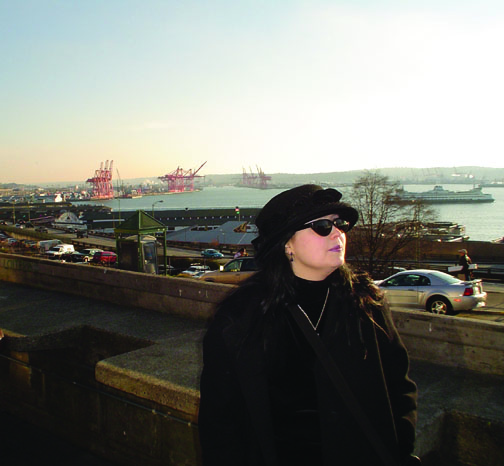
A photo he took of me at Pike Place Market on the day I called in “sick” at work.

But we couldn’t stop time and eventually he was up against the deployment date. We said a final in-person goodbye, promised to stay in touch to the extent possible (he didn’t yet know what kind of communications access he would have where he was going), and made no other promises except for him promising to return in one piece.

The process of deployment took several days (this is just how it works, apparently) and there were some phone calls as his unit hopscotched across the U.S. But there were also Livejournal posts from other people, and an odd uproar on the message board that his name got dragged into. Remember the part where I said that he was the attractive New Thing? Well, he’d availed himself of what came of that…and it appeared he hadn’t been entirely forthright with everyone involved. And that was a little concerning.

On one of the calls, I asked him about this, and he insisted that it was just a misunderstanding and explained it all. I still felt weird but I accepted it. I didn’t care much about whether he’d been seeing anyone else (we hadn’t made any agreements or set expectations of exclusivity—there wasn’t really time for that to happen), just that everyone affected be informed and clear about all of it.

And then a little later, on the verge of getting on the plane to leave the country (and be out of contact for at least a few days), he called me back and admitted that he had not quite been truthful in the last call, and that he had indeed not been entirely forthright with everyone. And then he got on a plane to another country.

He has acknowledged many times since then that he was, in his words, “a scoundrel.” He did not know how to handle all the changes in his life, along with a looming deployment, and he did not make good decisions. And in the times he was able to call me (and at least one other person) over the next several days, he had those poor decisions reinforced by the anger he was subjected to. (Again, I cared less about who was involved than I did about honesty and informed consent, which he did not handle well.) And there was a point at which I said I was done with any further conversations. It turned out that there wasn’t really opportunity for him to contact me for a while, as the remaining travel to his destination happened without options for calls, and he reached his destination and was introduced to the experience of being in a combat zone. And I used those several days of calm to reorient myself to my own life and get things back to normal.

When he called me again, he’d been through a few nights on patrol, and he asked me to please at least listen. He said that what he’d seen and experienced had changed him, that he understood that he had made mistakes and needed to be better, and that he hoped there would be something for him to think about returning to. And I listened, and decided that I would take him at his word, because there was something in me that just wasn’t ready to let go of who I thought he could be.

And that was the beginning of a relationship conducted largely in time-shifted emails, text chats at odd hours, a single phone call a day (if we were fortunate) that could be a couple hours or five minutes, and a handful of actual postal letters. The time difference was eleven and a half hours so one of us was always starting our day when the other was getting ready for bed. Each of us stayed up way too late on too many occasions. But the time-shifting also gave both of us the time and space to write thoughtfully, with care, and in depth. I gained new appreciation for the value of epistolary relationships (those 18th-19th century folks had something there) and for the way the constraints of separation changed how we related to each other and handled our interactions.

With nothing to do but talk or write, we learned a lot about each other, far more than we had in those conversations at the nightclub. We went into depth on our backgrounds, our families, and the painful relationships we’d both recently left. We discussed politics, values, ethics, and principles; we had differences, but the ability to discuss them in depth and in writing did a lot to find places where we were in accord. We went long on our interests and found we had a lot of them in common.

And eventually it became clear that we had found our way past the uproar and were into something that felt like it would continue to blossom. I told him stories about things going on with Seagoth, at the club, in Seattle; he told me about the violent absurdities of a combat zone and things he witnessed. He called me after members of his squadron were injured by old mines and told me how he couldn’t walk on any unpaved surface anymore. One morning he woke me up with a call and said, “I’m sorry, I broke my promise”—because he’d accidentally broken bones in his foot and wasn’t in one piece. (I forgave him for that.) I learned that he knew how to calm me, even at all that distance, when I spiraled into anxiety about my job, moving to a new apartment, trying to manage multiple priorities at once. He learned that I knew how to hold his fear and damage (because there was new damage simply from him being there) with care and help him find purpose beyond the war he was in the middle of.

I want to be really clear: Without this time of separation, we would not have a relationship. If it had all been in person, if we’d had to deal face to face with the febrile risk of limerence and the impact of his less-than-ideal decisions and the damage we were each carrying, we would absolutely have flamed out, one way or another. Those months of separation, time-shifting, and risk for him forced us to be more deliberate, to treat our conversations with care, to focus on what mattered in the core of each of us. I do not recommend war as a relationship device, not at all, and it was absolutely not enjoyable to have the separation. But for us, it ended up creating the circumstances for us to determine who we each were and what we were seeking. And as we found and shared those things, we became increasingly certain that we had something remarkable, and that we wanted to keep going.

The deployment was more than six and a half months in the end. He returned in the middle of me planning the memorial service for a dear friend who died suddenly and the grief and stress I had around that; it was very strange to be so happy and so full of sadness all at once, but he held up through it and for me. And I helped him navigate the return to a more normal life and the realization that he had PTSD.

And despite concerns we both had about resuming a relationship in physical proximity, it quickly became clear that what we had was wondrous, and that neither of us wanted to stop. Things weren’t perfect, but the skills we’d built over the months apart helped us through the challenging moments. And it started to feel like there was inevitability.

He asked me to marry him on October 12, 2004, six weeks after he returned from deployment and two days before my birthday. It didn’t come as a surprise; if he hadn’t gotten around to it within a few more weeks, I’d have asked him. He proposed on the dance floor at the club where we had first gotten to know each other and where a moment of thunderbolt and electricity told us to pay attention. It was quiet and private, not a big production, and in fact we didn’t tell anyone for a couple of days. (You can read the engagement announcement I wrote here.)

Later that month, we once again attended the Halloween party where we’d first met in person…costumed as Morticia and Gomez Addams, because that is, after all, Goth Couple Goals.

The perfect goth couple.

A little over six months later, we officially married.

Our wedding was held on a vintage ferryboat moored on Lake Union in Seattle; the ceremony was on the deck, with the city as backdrop, and then we had a delightful party inside. Our processional music was the theme from The Princess Bride. Our first dance was to Aztec Camera’s version of Cole Porter’s “Do I Love You,” and our final dance of the night was to “Storybook Love” by Mark Knopfler and Willy deVille, from the soundtrack of The Princess Bride. Every moment of it was perfect, even when everything didn’t go completely as planned.

Our wedding was the result of dozens of people in our community pitching in, for everything from our clothes to the décor to the cake to the music, and I am still so grateful to every one of them. Our wedding wasn’t “big” in the way the wedding industry defines that term, but there were a lot of people there, because it was crucial to us to share this milestone, this moment of transition, with the people who had helped us become who we were. I still think of that night with immense joy and gratitude, that this enormous life passage was exactly what I wanted it to be in all the ways that mattered.

The front of our wedding invitation, which I designed and did the layout for. Yes, we are VERY goth.

Of course, the wedding wasn’t the end of our story—it was the beginning of what we hoped would be our happily ever after. And it wasn’t that we married because That’s What You Do; we married because we knew, in ourselves and through long conversation, that we wanted to make that commitment to each other and to the life we wanted to have together. (And there were practical issues too—he got military benefits from being married that made our life together a little easier.)

So what has it meant to be married for 20 years?

For us, it’s meant knowing there is someone who loves and cares and supports and relies on you. It’s meant having someone to come home to and to help solve problems, someone to provide comfort and laughter and a meal and a cocktail, as needed, and to fill in where needed to support each other’s weak spots.

It’s meant supporting each other through the grief of losses, family members and friends and the pets we’ve brought into our home to be part of our family, and through the stresses of life, from a bad day at work to the COVID pandemic and the nightmare of this country’s democracy falling apart.

It’s meant so much laughter and so much silliness, memes and puns and dad jokes and obscure references that only we will get and ridiculous gifts and things our pets do, and parties where we get to share our home and our laughter with other people we care about. I have told him repeatedly that while I didn’t marry him because he makes me laugh, I would not have married him if he didn’t.

A dinosaur making a cocktail, very normal.

It’s meant adventures of all kinds, starting with that very first (and very, very big) one. Some adventures are small: Let’s go explore this part of our area, or let’s try a restaurant we heard about. Some adventures are huge, like moving cross-country to New Jersey for three years when he became a federal law enforcement officer after leaving the military, and then him quitting that job and us moving back to Seattle with nothing set up on the other side. Some are capers: Sneaking around closed event spaces on the Queen Mary after hours in formalwear and dancing in a hallway to “They Can’t Take That Away From Me,” or the time we crashed an outdoor wedding reception and had a long conversation with the bride’s three-sheets-to-the-wind father. Some are wretched, like our water heater lines forcefully disconnecting and flooding the lower level of our house, or when we both got COVID three years into the pandemic and had to isolate for nearly two weeks; some are sublime, such as watching humpbacks bubble netting in the waters off Juneau, or the two weeks we spent in Scotland last October.

It’s meant introducing each other to new things, and discovering new things together. He introduced me to wine (which I’d thought until then I didn’t like and now love) and cocktails, and the particular quirkiness of south Florida; I introduced him to fandom/media conventions and the fun of cosplay, and the awe-inspiring beauty of the Cascade Mountains. We shared our favorite films and shows with each other. Together we’ve discovered how much we love ice hockey, and film noir, and volunteering as naturalists, and so many beautiful places we’ve been to together.

A portrait I commissioned for our anniversary in 2024 to reflect our love of Seattle’s NHL team, the Seattle Kraken. Art by Ethan Kocak.

It’s meant working through the challenges, conflicts, and harm created by our own individual traumas and dysfunctions, and reinforcing the things that brought us together.

It’s meant navigating and understanding different frames of reference, from the differences in our class upbringing to expectations around issues such as money and housework to cultural frames due to age differences. (Oh yeah, he’s 12 years younger than I am. And absolutely true, I had a brief period of doubt when, as a postpunk kid, I realized he wasn’t old enough to remember the Sex Pistols.)

It’s meant figuring out how to work out serious disagreements with care and love and regard for each other, and what to do when we cause each other pain. Our wedding vows were statements of intent and permission, and one of them was, “Will you make each other angry?” “I may.” A number of guests laughed at that, but it was as important as the more traditional statements of love, partnership, and commitment.

It’s meant finding the pop culture references that reflect and explain us; for the sake of length I’ll avoid the full list here (you can see it at the end if you really want), but the first one was Nick and Nora Charles from The Thin Man films: detective stories, lots of cocktails, fabulous clothes, endless wisecracks, and devotion to each other. We still playfully call each other Mr. & Mrs. Charles and our home is The Charles Estate.

A reasonable facsimile of one of our parties.

And it’s meant supporting each other through a variety of health issues, some of which eventually healed, some of which are chronic, and one of which shares its start with our anniversary date—on our anniversary trip in 2011, I tripped on some stairs and ended up with neuromuscular impingement/damage that caused Bell’s Palsy I didn’t fully recover from, so our anniversary will always be linked with that.

It’s meant a lot of numbers that for me help measure the scope of all we’ve done since we married:

  • 5 homes lived in (4 rentals, 1 we own).
  • 2 states lived in.
  • 2 cross-country moves made.
  • 3 dogs and 5 cats (so far).
  • 4 cars (3 of which were technically his).
  • 4 employers for him, 3 for me.
  • 1 business started, which he began after he left his federal job and we returned to Seattle, and which we now own and work in together.
  • 4 significant surgeries between us; 3 ER visits for each of us; 1 broken bone for each of us.
  • 7 states visited together, plus 1 U.S. territory and 4 countries.
  • The equivalent of more than a year living apart due to assorted military and federal training requirements.
  • 3 months living in 5 motels after we moved back to Seattle (it took that long to find a home that met our needs & we could afford).
  • 2 hurricanes (Katrina, which we flew through *twice*, and Sandy) and 3 tropical storms experienced (one of which was in Seattle!), plus 1 significant earthquake (in NJ, with epicenter in VA, NOT in Seattle).
  • 1 viewing of Aurora borealis (in Seattle, in May 2024—but we’ve been to Alaska twice and never seen it there!).
  • 3 fashion shows (this is what happens when you’re goth, you end up knowing a lot of clothing designers).
  • Countless wine tastings done, cocktails shared, restaurants visited, special meals prepared, day trips undertaken, all of it part of joys that we have in common and that are sweetened by doing them together.

For us, marriage was not “this is just what you do if you love a person”; it was a considered, discussed, deliberate decision, that we made because we were confident the form and depth of our feelings for each other was meant to be long-term, and marriage was the best option for formalizing that. And we were old enough, experienced enough, and self-reflective enough to consider all of these factors and examine them before we made this choice and commitment. (And that is part of the reason that those six and a half months of separation back at the start were so crucial to how we made it to 20 years.)

Photo taken at Norwescon in 2008; I have misplaced the name of the photographer.

I hope for everyone who chooses to marriage to take a similar path. Don’t marry just because of limerence or desire; marry because you can’t envision living a life without this person in it and alongside you, for decades to come. The moment I knew this was what I wanted was when I found myself envisioning waking up next to him when I’m 80 years old.

And no, it hasn’t all been easy and joyous every moment; there have been hard times and there will be more in future, and don’t believe anyone who says they never have those moments. But what makes it work is our choice to find our way through those moments and try to improve and repair what’s gone poorly, because our marriage—our commitment to sharing our life together—is so important to us. A marriage is an entity, a living thing that is created by the people in it, and we are the ones responsible for maintaining that entity and making it grow and thrive.

I’m so glad, still, to be with him. We fit so well. We finish each other’s jokes and say the thing the other was thinking, because after all this time, we understand each other so well that we know what the punchline will be. We often anticipate what the other is going to suggest we do. We know what gifts (serious and jokey) that the other will like best. When we discuss business, we’ll work out our ideas and theories on a case in real time, coming up with pieces together and impressing each other with what we find out. (He’s a private investigator and I’m the operations manager—the Effie to his Sam Spade.) And we have maintained the sense of romance, the fairytale love and wisecracking delight and swooning devotion, because those things have never stopped being part of who we are and what our marriage is.

Here’s to 20 years of being married to my adventure co-conspirator, my business partner, my household support, my fellow pet guardian, my mixologist, my comedy relief, my always-there friend, the deepest and most sustained love in my life. Here’s to (hopefully) making it to 50 years, for all the reasons we’ve made it to 20.

Happy anniversary, Mr. Charles.

We Are Hopeless Nerds

So, if you actually got this far, I guess you want to read it: The list of other pop-culture characters that we are, in addition to Nick and Nora Charles. Here ya go.

  • Tony Stark and Pepper Potts from the MCU Iron Man. (This started with the very first film, including the Afghanistan sequence, and has remained very relevant; he has cosplayed Tony numerous times.)
  • Sterling Archer, with a bit of Krieger (him); bits of Lana Kane, Mallory Archer, and Pam Poovey (me), from the animated series Archer. (There are times when he is being particularly Archer-ish that I have to say in exasperation, “NOT A ROLE MODEL.”)
  • Jake Peralta (with a bit of Rosa Diaz) for him, Amy Santiago (with a bit of Kevin Cozner) for me, and differing pieces of Raymond Holt for each of us, from Brooklyn 99.
  • Lucifer Morningstar and Dr. Linda Martin from Lucifer. (No, I am not really Chloe—I am DEFINITELY Linda.)
  • The best (and a bit of the worst) of Eleanor and the Floridian of Jason (him), and most of Chidi (especially the anxiety and decision paralysis) and the know-it-all-ism of Janet (me) from The Good Place.
  • Dewey Duck and Webby Vanderquack from the latest version of DuckTales.
  • Beast Boy and Raven from Teen Titans Go! (Someday, if the world is safe enough for us to go to a convention again, we want to cosplay the elderly versions of these two.)
  • Bob Belcher (me) and both Gene and Louise Belcher (him) from Bob’s Burgers.
  • Combo of Ron Swanson and Andy Dwyer (him), and Leslie Knope and April Ludgate (me) from Parks & Recreation.

On the Edge of Spring

It’s the middle of March, and the past couple of days here in the Seattle area have been mild and sunlit with clear skies. This is when those of us who live here know spring is on the way. It’s not that this weather will endure; we will have many more days of gray skies and drizzle before spring fully takes hold, and those days may spill well into summer. But days like this tell us that spring is coming, that the trees and flowers are budding, that the darkness of winter is on the way out.

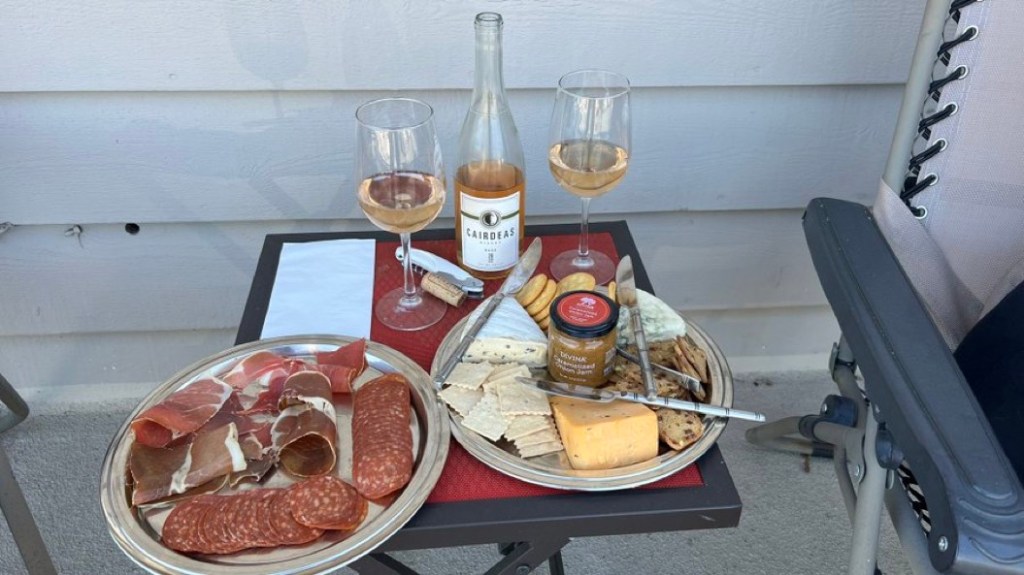
When days like this happen, my spouse and I like to do what we call Balcony Afternoons. We have a balcony directly off our bedroom, large enough to accommodate us and some lounge chairs and a small table and our pets (as well as a feeder for the hummingbirds). Our house is at the south end of a lake, and while our neighborhood is decidedly humanized and suburban, we can see the lake and the hills that ring it and the birds that float and feed on it and old growth trees that haven’t been torn out to make space for the humans, as well as the soaring sky. These days are brilliant and precious, and we want to experience them and cherish them. We go outside for a couple of hours with a bottle of wine and some snacks, and just enjoy the time outside.

We’ve lived in this house for seven years (as of the end of this month). It was always intended as not just a home but a refuge, and for more than half the time we’ve lived here it’s been a near-constant sanctuary from the pandemic as well as our home. We chose this house because of the lake and trees and birds and balcony, among many other reasons, and we cherish those things each day but especially on days like this.

The past several months have been…a lot. We’ve had individual and family struggles, including death and injury and illness and turmoil. Six months ago, I quit a job I’d held for nearly a decade, after years of overwork and burnout and unmanageable expectations, and it was less to go to something new than it was to simply end the ongoing damage. I’m still not recovered from that and I don’t know when I will be. I’m still figuring out who I am outside of that job and that workplace and whether I’ll ever return to a lot of things I love to do (which, not gonna lie, included things I did in that job). But on this edge of spring day, I can feel both respite and hope as I sink into the view and the warmth and all the signs of the world cycling back to spring for this year.

I’m a native of the Pacific NW, and I’ve lived here the majority of my life. I know the rhythm of the seasons here and I expect the darkness and damp of autumn and winter. To be honest, I cherish autumn here; the first part of it remains lovely and dry more often than not, with pleasantly crisp days and autumn colors and the pleasures of coziness, and then comes Spooky Season, which I especially appreciate as an avowed goth. I love autumn twilight and bare branches and mist and the need for extra light, as we move towards the prime gothy holiday; and even after All Hallow’s Eve, we move into the defiant sparkle and hearty pleasures of the end of year holidays, which help stave off the worst of the dark and damp as we approach the winter solstice. But I won’t lie: the time after those end of year holidays and through January is rough, and eventually even I have had enough of the dark and damp.

That’s why these days on the edge of spring are so precious: they are the end of the rough dark times and a sign that brighter times are ahead. I will luxuriate in the brighter, warmer days of spring, in the return of spring/summer migrants and the blooming flowers and the phenomenal greens that we have in summer to complement the evergreens we’re fortunate to have year-round and the opportunity to sit on my balcony and revel in the lake and sky and trees. Eventually it will get hot (which didn’t used to happen, but our climate is broken so it’s always hot in summer now), and things will get dry and brown, and we’ll probably have fires and smoke that make summer difficult to fully savor. When autumn comes around again, I’ll be more than ready for it. But right now, we are in the part of the cycle where the dark and cold starts to retreat and the brightness returns, and right now I need that.

Today we had a rosé from a favorite winery in the central part of the state and some delightful cheeses and a luscious onion jam (and charcuterie for my spouse). One of our neighbors ran his power washer for a couple of hours; when he finally shut it off, the absence of its noise highlighted the pleasant background noise of our neighborhood. A Bewick’s wren sang his burbling running-brook song, because it’s that season, and the chickadees and Steller’s jays called at each other. A pair of adult crows billed and groomed atop a tree down the street, while the adolescent crows fluttered around the neighborhood in a gang, yelling and playing. Nothing unusual for this time of year…but special and beautiful all the same, every time. And I’m grateful we have more of this to come as spring fully expands.

The Feline Version of Zoolander

Today we unexpectedly had to say goodbye to our smaller cat, a former feral lynx point Siamese mix named Squish. He had abrupt catastrophic renal failure, and may have had cancer. It was an absolutely heartbreaking start to the day. He’d been with us for 15 of his 17 years and we have deep love for him. He was sweet, soft, pretty with beautiful blue eyes, easily confused, and not particularly gifted with intellectual ability. Because of this, we often called him the feline Derek Zoolander. And in honor of him, I decided I would share one of the most mind-boggling stories of his time with us, which beautifully captures what kind of cat he was.

Originally published elsewhere on Feb 15, 2007.

In a corner of our office sits a pair of ankle-high lace-up stompy boots. They are sitting there because I’m getting rid of them and haven’t yet bothered to retrieve the “get rid of” bin from the shed.

Earlier this morning, Squish began playing with the laces of one of these boots. He often plays with boot laces, so this was understandable. However, I generally prefer that cats not play with stringlike things, so once I realized he was doing this, I called his name and stood up to go over to him and remove the laces from his possession.

As he generally does when approached by a human while he’s playing, he started to scamper away. However, he had apparently gotten one of the boot laces caught in his collar or wrapped around his body somehow, and thus the boot came along with him as he scampered.

This, naturally, upset him, and so he tried to run away from the boot that was chasing him. And of course the boot just chased him faster.

He ran down the stairs in a blind panic, the boot bumping along behind. He scrabbled madly on the hardwood floors downstairs, desperate to escape the evil footwear bearing down on him, but it remained in remorseless pursuit. He ran back up the stairs, his lug-soled nemesis still on his trail, thumping evilly in his wake. He finally ran behind Spouse’s dresser, where the boot got caught because it was too big to fit and pulled free of him.

We stood dumbfounded watching and listening to this horror unfolding before us.

And then we laughed our damn asses off.

Squish is under the bed now, and we fully expect he will remain there for at least the next eight hours or so. I do of course feel terrible at how scared he is…but not so terrible that I fail to find this completely hilarious. Yes, I am an awful person. Everybody knows this already.

The boots are both back in the corner of the office, sitting peacefully, giving no indication of their true cat-torturing nature. However, I’ve tucked the laces in so they can no longer be pulled on by curious, boot-naive kitties.

A representative photo of Squish.

Noir Alley February 27, 2021: Odds Against Tomorrow (1959)

This is an exercise to write a review each week of the films of Noir Alley, the weekly broadcast of a noir or noir-adjacent film on TCM hosted by Eddie Muller. I’m borrowing an idea from film & TV critic Matt Zoller Seitz and limiting each review to roughly 30-40 minutes of writing, as much because I’m not up for a long writing stretch at 11 p.m. on a Saturday night as for any real discipline.

Odds Against Tomorrow is a use of the heist-gone-wrong trope with some intriguing twists: it pairs an unrepentant racist (played by Robert Ryan, who excelled at furious, self-loathing men who wrecked their own lives) with a black jazz musician (Harry Belafonte) and a dirty ex-cop (Ed Begley Sr) in a heist plot that would, in theory, solve all their problems. Slater has no job and is being supported by his devoted wife (Shelley Winters) but hates it. Ingram (Belafonte) is deep in hock to a local crime boss because of his gambling addiction, and has put his ex-wife and beloved daughter at risk. And Burke (Begley) has run out of options due to his own corruption; somehow, stealing money from a bank in a small town in upstate New York seems like the best option to him, and he cajoles Slater and Ingram into helping him.

This isn’t a new or innovative story; what makes it work is the dynamics. Slater’s fury at having to work with a Black man who is in almost every way superior to him drives the story forward. His racism gets in the way at nearly every turn, causing him to make choices that jeopardize the heist plan, and make Ingram distrust him. Ingram himself feels trapped into needing to take this job because of threats to his family, and he resents needing to rely on a racist and another white man who doesn’t grasp the threat of the racism. It’s all explosive (kind of literally) and leads to a powerfully tense and upsetting final act.

Belafonte produced this film and was adamant that he wanted a story that dealt realistically with the racism and the heist. There’s a complex and fascinating back story that I don’t have the capacity to detail; you can find it from a variety of film history sites. But the film doesn’t go easy on the complexity of the racist dynamics. Ryan’s character is introduced using a deeply upsetting slur to refer to a little Black girl, and it’s not the last slur he uses. There’s a series of scenes that start with Belafonte discovering his ex-wife working with a multiracial PTA council, and when his ex criticizes him for his gambling and drinking, he goes off on her about “collaborating” with white people in an attempt to be more palatable—he’s not wrong, but his own personal choices complicate the criticism he’s making. It’s powerful language and provocative concepts for a film made in 1959, and could easily be used in a contemporary story with few changes.

But the film is about more than the racist dynamics, and all of it is beautifully woven together by director Robert Wise. If the general public knows Wise’s name, it’s most likely for his work in musicals or maybe The Haunting or Star Trek: The Motion Picture. But he worked on an enormous range of genres, including film noir, and he understood the tropes and conventions of every genre in a way not many directors manage even today. This film is a feast of shadows and light, moments of tenderness and tension, contrasts between the harsh reality of Slater’s rage and loathing and Ingram’s life as a jazz musician and divorced father. The film is full of sharp lines and harsh contrasts; sometimes it can feel overly obvious, but it never feels pedantic the way some race-focused films can be.

Ryan, Belafonte, and Begley are all excellent, but they’re not the only greatness in this. This may be my favorite of Shelley Winters’ films. She is warm, fiercely devoted to her husband, working two jobs to make sure they get by, but keenly aware that her successes feel like humiliating failures to him. Too many directors took advantage of Winters’ emotional openness and overt sensuality to have her play characters who feel desperate and cheap. Lorry never feels like this; there’s a dignity to her, and deep authenticity in her affection for Slater and her understanding that her professional success feels like a slap in the face to him.

And Gloria Grahame, in a role developed specifically for her by Wise at a time when she was nearly unemployable (thanks to Eddie Muller for explaining this), has a small but powerful presence as Slater’s odd, kinda kinky neighbor who is desperate for a man to look at her as a worthwhile sexual being. The role isn’t vital to the plot, but it adds dimension to Ryan’s character, and provides Grahame the opportunity to demonstrate that her femme fatale style and presence still mattered. In a different time and with a different director, Winters and Grahame might have swapped roles; but they’re both perfect in these parts and add enormously to the texture of the film.

Kim Hamilton as Ruth, Ingram’s ex, is also a strong presence. She clearly still cares for him, but her priority has to be their daughter. In some ways her role is somewhat thankless; she offers the perspective that dealing with racism is a price she has to pay to protect their child, and that her responsibility compared to Ingram’s recklessness is what matters most. But in a film that’s largely focused around the men, she and the other two women demonstrate that the choices of the men are reckless and harmful.

There are also some really excellent scenes set in the jazz club where Ingram performs. The film has a truly spectacular jazz soundtrack by the Modern Jazz Quintet and two sterling songs by Belafonte and Mae Barnes. These scenes give us a real sense of Ingram’s context and life, and contrast with the strangled miserable racism that Slater engages in; Ingram has his problems and poor decisions, but he’s living a life full of music and passion, which is one of the things Slater hates him for.

I had seen this movie once before, when it aired on Noir Alley a couple of years ago, and I found that I remembered beats of it (fitting due to its jazz grounding) but not as much specific scenes. It’s considered one of the last films of the “classic” film noir era, and a major influence on nouvelle vague filmmakers in France. The film’s tone is definitely influenced by the aesthetics of the Beats and the jazz and Black culture it draws from. It’s both a classic noir story, and a glimpse at the post-noir future. It definitely deserves a higher profile among noir fans, in large measure because of its willingness to include race in the story it tells.

Noir Alley February 20, 2021: Native Son (1951)

This is an exercise to write a review for each edition of Noir Alley, the weekly broadcast of a noir or noir-adjacent film on TCM hosted by Eddie Muller. I’m borrowing an idea from film & TV critic Matt Zoller Seitz and limiting each review to roughly 30 minutes of writing, as much because I’m not up for a long writing stretch at 11 p.m. on a Saturday night as for any real discipline.

This is an attempt to put Richard Wright’s renowned novel of the same name into film. The novel’s plot and themes were so incendiary in its era that a film of it couldn’t have been made in the U.S. This production was filmed in Argentina, by a French director, starring Wright himself as the lead character of Bigger Thomas, despite being both too old for the role and not an actor. The production story is remarkable in itself. And it’s an intriguing choice for Noir Alley, especially in the context of Black History Month; very little traditional noir features or focuses on Black stories or characters.

There’s no question this film fits the canon and themes of film noir. Bigger gets into a bad situation and makes decisions that compound the awfulness of his circumstances; it features shadows and neon, double-crosses and police misconduct, and even a blonde femme fatale. But the context of the story, of a Black man who is brought into the world of wealthy white people and immediately falls into danger, is genuinely extraordinary in this genre. If this story featured all white characters, it would have gone differently. But Bigger, as a black man reliant on the favor of his white employers, doesn’t have the privilege of refusing their requests, and the choices he makes are all to some degree driven by the knowledge that if (when) he gets caught, there will be no mercy for him. The setup of the story is fairly standard noir; the structural racism that suffuses it means it feels far more serious, and far more upsetting, than a standard noir plot.

This is not, technically, a good film. It’s stagy, deeply self-conscious, overly earnest, and substitutes awkward speechifying for what ought to be nuanced dialogue. (The courtroom scenes are particularly uncomfortable in this regard.) The plotting doesn’t convey much of the seriousness and complexity of the story. Many of the actors didn’t speak English and had to be dubbed, and the lack of language context affects the performances. Wright himself is aware that he’s wrong for this role and his discomfort with acting is often evident in how he stands and the way he speaks a lot of his lines.

And yet, none of this is as important as the context. Wright understands and portrays Bigger’s fear and desperation in a profound and intuitive way, not just because he created the character but because he’s also a Black man in America. In the early part of the film, after he first gets the job as chauffeur to a wealthy white family and takes his girlfriend for a trip in the expensive care he’s been hired to drive; these scenes carry a sense of giddiness at how the car enables them to move in white spaces they might otherwise not have access to, but also an underlying anxiety, glances over the shoulder, at the possibility they’ll be called out.

The instrument of Bigger’s downfall is his employer’s party-girl daughter (and her Communist-playacting boyfriend), and the scenes in which they demand he goes with them to the good clubs around town, including the one he hangs out at, are uncomfortable from the start and get increasingly anxiety-making. These wealthy white folks fancy themselves as allies, saying they understand what it’s like for Bigger and urging him to rebel against Jim Crow, in language that can still be heard from these types of white people 70 years later. But they do nothing to actually help with this struggle they supposedly support, and they’re oblivious to the dangers their behavior presents to him. There’s a scene in the nightclub where the party girl demands to be introduced to Bigger’s girlfriend, who refuses, but the party girl just pushes her way into the dressing room and starts fawning all over her, touching her and offering her things. This behavior is so predatory it’s painful to watch, and it’s depressing that this kind of behavior still happens.

From there everything goes rapidly downhill, and the scene that seals Bigger’s fate is both agonizing in how tense and upsetting it is, and infuriating in how pathetic and stupid the decisions are. It’s obvious early on that the blonde party girl will wreck him, and that’s the most depressing thing: It would happen one way or another, because she’s a young, rich white woman, and he’s a Black man.

I think a better film could be made from this material (and I’ve seen some discussion that the 1986 TV movie does that). But I’m not entirely sure one could be made that feels as urgent and harrowing as this one. There’s a scene where police are sweeping the floors of a Black tenement, driving the terrified residents through the hallways for no reason but intimidation; the camera work pans across the exterior windows and zigzags up the floors of the building, showing how brutal this action is. In another scene, a fire hose is turned on Bigger, and it’s impossible to watch this without thinking of footage of protests during the civil rights movement and how this was a tool for controlling and harming Black people. Despite the flaws of this film, it’s immensely powerful as a visual representation of structural racism.

For additional context I recommend film writer Odie Henderson’s article about his reaction to the film when he first saw it in 2013. I can give you my impressions, but I’m a white woman and there are things I can’t fully grasp, regardless of my commitment to anti-racism.

February 2021 Get Out of a Rut Project day 12

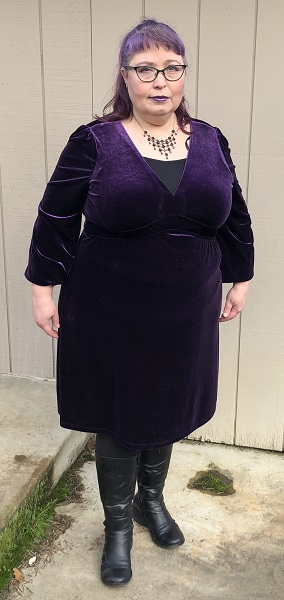
Well, I got out of a rut today: Instead of numb depression and fuzzy executive function, I zoomed straight into unmanageable rage and despair. There are so many things happening right now that are horrible beyond words, and I am under major pressure around work responsibilities, and I couldn’t handle it. When it came time to choose an outfit I decided I wanted one that makes me feel sleek and badass (even though I’m never going to actually look sleek and badass because of how I’m built). Then that nearly fell apart when the boots I wanted didn’t fit, since shoe manufacturers don’t believe women with big calves deserve stylish, quirky leather boots. So I just picked something else and here’s what it came out as.

Purple velvet dress: Lane Bryant via Goodwill
Black knit cami: Soft Surroundings
Black leggings: Roamans
Black wedge boots: Miz Mooz
Amethyst & onyx cabochon jewelry: Angelwear Creations
Makeup—Aromaleigh except lips and mascara
Foundation, concealer, undereye: standard
Contour: Orpheus & Eurydice Deathly Pallor
Eye shadows: inner half of eye, Irregular Impulse; outer half, Lost in Faerie Caelia; crease and under lower lashes, Mythos Erebos (all discontinued)
Liner on top lid: Tesla Alternating Current (LE)
Mascara: standard
Rouge: Get Cheeky! Smolder (discontinued)
Highlighter: Fatalis Solanum dulcamara
Powder: Glamoured Avena
Lips: NYX Cosmetics Suede Matte Lip Liner Amethyst, Black Label Lipstick Seduction (discontinued), Shimmer Down Lip Veil Fortune Teller (discontinued)

At the time I bought this dress, it wasn’t a style I typically wore: too straight, too short, high waistline. But I ended up pleased with how it fit. Flashing back to my rants about waistlines early in this project, it turns out that this type of high waistline that curves up under the bust and then lower in back does work on me. The typical straight empire waist is impossible for my build, but this style (which is more Regency-influenced) provides more definition and lets the skirt flow in a way that doesn’t highlight (what I think is) the worst about me. This discovery was also happy because waistlines like this are common in many 1930s and 1940s styles, and helps me find dresses that can go with my Noir Dame aesthetic.

There’s nothing wrong with these boots in and of themselves; you’ve seen the style already in another color. But this particular outfit, to me, calls for a tall boot with a tallish heel and more pointed toe, and the pair I have that meets those criteria is not fitting these days because of pandemic bloat. When I was already feeling on a razor edge of emotion because of other things, having that happen made me fragile and self-loathing. Since I barely hold those feelings off on good days, there was no way I was going to be able to manage them productively today. And that just increases the feelings of self-loathing, because vicious cycles are durable.

I’m questioning whether I have the fortitude to continue this project. The last few days have felt stressful and unpleasant because of other responsibilities and doing the outfits hasn’t been fun. I’ll see how I feel tomorrow.  But it could end here.

February 2021 Get Out of a Rut Project day 11

As you can see from the numbering, not only was there not a bonus outfit, there wasn’t even an outfit on a scheduled day. A weird combination of things on Monday gave me all the effects of a migraine (though it was not one in practice) and I just couldn’t deal with outfitting. I was able to sketch out the outline of an ensemble for today before bed last night, which was helpful when I woke up more than an hour before my alarm this morning and developed a bunch of additional aggravations over the course of a day. So at least I was capable of doing the project today.

Sentence-diagram knit top: Svaha USA
Long knit skirt: April Cornell
Plum & lilac striped socks: Sock Dreams
Shoes: Fluevog Wicked Thanks
Knit & lace scarf: Target
Iridescent glass flower bead pendant & earrings: Designs by Victoria (no longer operating)
Makeup—Aromaleigh unless otherwise stated
Foundation, concealer, undereye: standard
Contour: Medousa Menagerie Amphisbaena
Eye shadows (all discontinued): lid, rocks! stillinhollywood; browbone & inner corner, Lost in Faerie Rosina; crease & outer corner, Eye Lustre Isabella
Liner: Gothic Lolita Elegant Reverie (discontinued)
Mascara: standard
Rouge: rocks! wildflower (discontinued)
Highlighter: Catherine of Aragon Humble & Loyal
Powder: Gothic Lolita Moonbright (discontinued)
Lips: NYX Cosmetics Powder Puff Lippie Senior Class

In retrospect, this outfit leans a bit “ceramics teacher at the new age women’s center,” which isn’t entirely my style, but I think it’s coherent within itself. I don’t wear long skirts these days as much as I used to, but this is one of my most reliable pieces and it’s comfortable when I’m dealing with tired and achy days.

Svaha USA, where I got the top, specializes in nerdy STEAM designs; most of their ideas are inspired by hard sciences, but there’s a subset of their designs that comes from various facets of publishing. This top features that hardcore and now little-scene grammar process, sentence diagramming, and the sentences diagrammed come from works including Alice in Wonderland, Anne of Green Gables, and Sense & Sensibility. Being a writer and editor, I was tickled by the concept, and the fact that it was purple made it a must for me. Svaha’s clothes are made well and a lot of it is in soft organic cotton knit, and many of their items come with pockets (though not this top, as it happens). And their sizing goes up to 4X, plus they have kids’ clothes and fun accessories. I like them a lot and have several other pieces, including a skirt with proofreading marks and another with typewriter keys.

I love these shoes so much. They’re the most comfortable heels I’ve ever worn. I randomly bought them off eBay when I found them for a fairly low price (for Fluevogs), and when I got them immediately regretted that I hadn’t bought every available color and style when they were in stores. They hit everything I need in shoes: a distinctive, quirky style; wide enough for my cranky feet; arch support; super comfy rubber soles; and a thick, solid heel that doesn’t strain my feet or my back. I continue to hunt for other styles, but more than a decade since they were released, I know it won’t necessarily be easy. Today, they were right for how tired and aggravated I was.

Maybe tomorrow will be a better day.

Of fairy tales and happy beginnings

Originally published elsewhere on October 13, 2004


My love is like a storybook story,
But it’s as real as the feelings I feel

Once upon a time, there was a princess whose heart had become encased in ice.

Once upon a time, there was a knight who had fallen short in his quest for love.

They met on a night of masks, and neither quite saw the other, though they each remembered meeting.

They met again in friendly contest, and the knight thought he saw something lying underneath the ice around the princess’s heart. They met again several times after that, in conversation and companionship, and the knight became more certain of what he thought he saw. The princess was intrigued by what she saw in the knight, but the ice around her heart held her back.

At the height of winter, there was a grand ball, and the princess sparkled and shone, surrounded by people and ideas she held dear, and she was filled with warmth, and at the end of the ball she embraced those around her, including the knight.

And at the moment of their embrace, a thunderbolt struck, and cracked the ice around the princess’s heart. And for the first time, they saw each other through the ice, and the world was suddenly about nothing but what was between their eyes. But they said nothing of it.

In the light of morning, the princess was almost certain she had imagined it all. Yet the knight kept finding his way into her dreams, and what she had felt seemed oh so very real. Finally, fearfully, she sent a whisper out onto the wind, only half-certain herself of what she was whispering, and why she was sending it.

Somehow, the knight caught it, and understood it, and brought it back to her. And they both saw that what had been between their eyes hadn’t been imagined.

But the knight had been called to war, and they had been given only a few days before he had to leave, and he was determined to show the princess the power of what had erupted between them. The princess tried to be prudent in all things, but there was no time for prudence here. The ice tried to hold her to it, to hold her back, and she fought valiantly, but the ice was already cracked.

I’ll be fine
I’ll be waiting patiently
Till you see the signs
And come running to my open arms
When will you realise
Do we have to wait till our worlds collide
Open up your eyes
You can’t turn back the tide

The first day, he kissed her under the leading edge of the moon, and the ice began to melt. The next day, he took her breath away to a song, and the ice melted further. The day after that, he showed her the depth of his heart, and the ice melted completely. And on the final day, before he rode away to war, she gave him her heart, now warm and alive, to take with him.

My love is like a storybook story,
But it’s as real as the feelings I feel

Even the storybooks have sorrow, and for a time, the knight broke the princess’s heart, the one she had given into his care. She tried in fury to take her heart back, she tried to grow the ice around it again. But her heart wouldn’t come back, and the ice wouldn’t grow. And the knight, his eyes opened by war and by what he had nearly cost himself, vowed to repair what he had broken. And over the long months of war and separation, the princess’s heart was repaired, not just from what the knight had done, but from things that had torn and scarred her even before the knight came to her, and the knight began to see new purpose in the quest he thought he had failed.

When the knight at last returned from the war and to the princess’s arms, her heart blossomed, and with every day that passed, she found herself grasping more and more of what she thought had been lost to the ice. With every day that passed, they both became more certain of the love they had once thought beyond them.

Don’t say you’re happy
Out there without me
I know you can’t be

On the night that the princess celebrated all the joy and blessings of her life, the knight asked the princess to dance with him to the song that he had taken her breath away to all those months earlier. And when the song was over, he asked the princess if she would give him her hand as she had given him her heart, and take his in return, and share the rest of her life with him.

Isn’t it strange how sure you can be when you find the one you want…

And the princess looked in his eyes, and she answered, “Yes,” because there could be no other answer.

And he said:
“Don’t you know I love you oh, so much,
and lay my heart at the foot of your dress.”
And she said:
“Don’t you know that storybook loves,
Always have a happy ending.”

Will they live happily ever after? No one can know that. But they’re going to try with all their might, as hard as anyone has ever tried.

My love is like a storybook story,
But it’s as real as the feelings I feel.


Lyrics–all rights and credits to original authors:
Mark Knopfler & Willy DeVille, Storybook Love
Depeche Mode, It’s No Good
Lene Lovich, It’s You, Only You (Mein Schmerz)

February 2021 Get Out of a Rut Project day 10

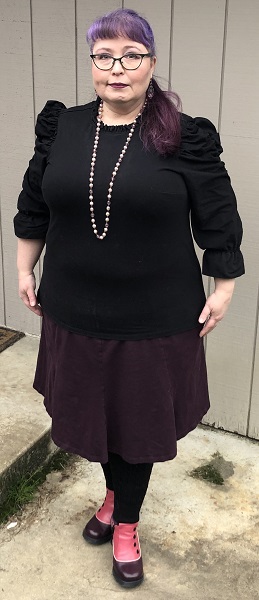
This was a day when I did not even manage to get dressed until I finished work, because it took every resource I had just to keep up with the work day. Not only did I not get dressed, I didn’t even have an outfit planned. When I finished work I stood in my dressing room for 10 minutes, picking at various pieces of purple clothing until I managed to assemble an ensemble, and another 10 minutes fussing through jewelry because it was absurdly difficult to find a necklace that felt right. I like this outfit in concept, but it was so much effort to put together that I feel kind of resentful of it.

Black knit neo-Victorian top: eShakti
Dark purple skirt: eShakti
Cabled sweater leggings: Roamans
Shoes: Fluevog Mini Bunny
Necklace: Fred Meyer
Earrings: 1928 Jewelry
Makeup—Aromaleigh unless otherwise stated
Foundation, concealer (forgot the undereye!): standard
Contour: Orpheus & Eurydice Deathly Pallor
Eye shadow (all discontinued/LE): inner lid, Moulin Rouge Soiree; browbone and down to inner corner, Earth Sea Sky Petalsweet; crease and outer corner and under lower lashline, Starry Night Shaula
Liner: rocks! blackangel (discontinued)
Rouge: Jane Seymour Sweets and Wine (discontinued)
Highlighter: Galactic Stelliferous Era
Powder: Orpheus & Eurydice Beloved
Lips: NYX Cosmetics Soft Matte Lip Cream Transylvania

I’m sure there’s someone out there thinking “Caterpillar sleeves were two years ago.” But I was SO THRILLED to find this neo-Victorian style in comfy jersey knit that I bought it in every color they had, because neo-Victorian is forever and not having to feel constricted is a big bonus.

The Fluevog Mini family is my last hurrah for high heels. I wrecked my feet wearing cheap pointy-toed pumps with high spike heels and cheap no-arch-support flats in the 1980s, and arthritis and knee injuries finished what the bad shoes didn’t. My body called foul on anything over a 3-inch heel years ago, and even much over 2 inches has been difficult the past few years; and any kind of slender heel has been no go for ages. But somehow, the 3-inch Mini heel works, with the wide stable base helping to spread out the heel pressure. It’s not “walk a mile” comfortable, but for a typical single day with ordinary walking around, it works. (It helps that the shoes are wide and have good arch support, so I don’t feel uncomfortable in other ways.) And I love the playful neo-Victorian feel of this style, especially in this warm purple/warm rose/powder pink combo.

Yes, I coordinated my eye shadows with my shoes. I have warned you about my matchy-ness. It’s not uncommon for me to build an entire outfit or color scheme around a single item.

There may be a weekend outfit, depending on whether the pending winter storm wrecks our Valentine’s Day plans and I get too petulant about it to bother. Considering that I was almost too cranky to bother today, I would recommend not getting your hopes up.

Get Out of a Rut project day 9

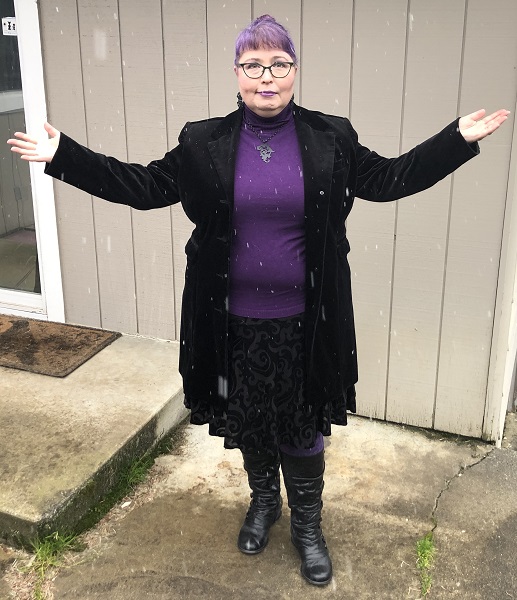
Snow! We’re having our first snowstorm of the winter. This one isn’t expected to amount to much, which is my favorite kind of snow. It’s also quite cold, so layers and warmth were called for. I was thinking about a version of this outfit for yesterday before the meltdown happened; today was better, so I thought I’d go ahead and do it today.

This image has an empty alt attribute; its file name is feb2021gooarday09-full.jpg

Black velveteen jacket: J. Peterman
Purple silk/cotton turtleneck: Chadwicks
Burnout velvet skirt: Value Village
Swirly purple leggings: Woman Within
Black ruffle & button boots: Miz Mooz Bloom
Black metal baroque pendant: Fable & Fury
Black metal baroque earrings: Fred Meyer
Makeup—Aromaleigh unless otherwise stated
Foundation, concealer, undereye: standard
Contour: Orpheus & Eurydice Deathly Pallor
Eye shadows: lid, Hot in the City Girls Night Out (discontinued); crease, Ciao Italio Fruitti di Bosco (discontinued); browbone, En Pointe Dulcina (discontinued)
Liner: Butter London Glazen liner Ultra Violet (LE)
Mascara: standard
Rouge: rocks! wildflower (discontinued)
Highlighter: Fatalis Solanum dulcamara
Powder: Gothic Lolita Moonbright (discontinued)
Lips: NYX Butter Gloss Gelato (shade may be discontinued by they still have this line)

This image has an empty alt attribute; its file name is feb2021gooarday09-closeup.jpg

This outfit features one of my other personal motifs: swirly designs that feel rococo and/or evoke vines and leaves. I really love 18th century style (my wedding dress was based on an 18th century robe anglaise design), and the vine/leaf thing is another side of my goblincore tendencies—vines always feel wild and vaguely ominous to me, the potential for out-of-control growth smothering all else. (As I mentioned earlier in the week, Maleficent was my first goth influence.) I’m also very fond of spirals, and that can be reflected in vine patterns as well.

I don’t have a lot else to say on today’s ensemble. I like it and it’s good for the weather. And I enjoyed taking some violets out into the snowstorm.